Showing posts with label Radar. Show all posts

Pakistan To Build Radar For JF-17 Thunder Fighter Jet


The chief of staff of the Pakistan Air Force (PAF) has told Jane's that Pakistan has built its first facility to manufacture radars for fighter aircraft.

Air Chief Marshal Rao Qamar Suleman said the indigenously produced radar, built with China's assistance at the Pakistan Aeronautical Complex (PAC), in Kamra, north of Islamabad, would equip the JF-17 'Thunder' fighter aircraft jointly produced by the two countries.

"This is a major step forward. This will be the first such [radar manufacturing] facility in Pakistan," ACM Suleman said in an interview on 21 December at PAF headquarters in Islamabad. He confirmed that the radar would be fitted on the JF-17, which, along with US-supplied F-16 Fighting Falcons, is set to be the PAF's front-line combat aircraft.

Previous reports suggest that the radar to be manufactured will be the Chinese-built CETC/NRIET KLJ-7 radar set.

At the 2010 Farnborough Air Show, at which two JF-17s made their debut in the West, Jane's reported that the KLJ-7 had received full marks from the JF-17's designers at PAC.


A PAC programme officer told Jane's : "I have flown with this radar and with other models that we have looked at fitting to this aircraft, such as the Thales RC400, and the Chinese radar is every bit as capable as its contemporary analogs."


Indian BEL Weapon Locating Radar

Procurement Of Radars By BEL Being Examined : Antony


Defence Ministry is examining the issue of defence PSU BharatElectronics Limited (BEL) procuring radars from foreign sources insteadof developing them indigenously, the Lok Sabha was informed today.

The matter was first raised by the CAG in its report tabled in Augustthis year which states that BEL was given an order of Rs 870 crore for22 surveillance radars but instead of producing them indigenously, thecompany used 60 per cent of imported content to make them.


"The issue raised is under examination in the department. The decisiontaken will be placed before the Parliament," Defence Minister A KAntony said in reply to a written House query.

BEL is the major supplier of radars and other surveillance equipment tothe Indian armed forces which include the indigenously-developed INDRAradar.


Northrop Grumman G/ATOR Radar Is Candidate To Replace US Old Radars


 On the eve of the Air Force Association's annual fall conference inWashington, Northrop Grumman is pitching its G/ATOR multi-mission radaras a candidate to replace the U.S. Air Force's AN/TPS-75 air defenseradar. 

Managed by the U.S.Marine Corps' Program Executive Office Land Systems, G/ATOR is beingdesigned to replace five Marine Corps radars to perform air defense,counter-fire target acquisition and air traffic control missions.


Northrop is pitching G/ATOR for the Air Force's Three-DimensionalExpeditionary Long-Range Radar (3DELRR, pronounced Three Dealer)program, an effort to replace the AN/TPS-75 radar, which has been inservice since the late 1960s. 3DELRR, currently in the technologydemonstration phase, is intended to be the Air Force's futurelong-range, ground-based sensor for detecting, identifying, trackingand reporting aircraft and missiles.
At a Sept. 8 media briefing,Northrop officials argued that by selecting G/ATOR, the Air Force couldsave time, money and manpower.

Contracts for the first phase of3DELRR were awarded in May 2009 to a team led by Lockheed Martin andanother led by Sensis Corp.

Northrop anticipates an Air Forcerequest for proposals for the next phase of 3DELRR by the end of thisyear. The request is part of a full and open competition, said JeffPalombo, a Northrop sector vice president and general manager of thecompany's Land Forces Division.

The company is pitching G/ATOR as a 90 percent solution at 50 percent of the cost.
Accordingto Palombo, G/ATOR meets 81 percent of 3DELRR's mission requirementsagainst air-breathing targets and 92 percent of its missionrequirements against theater ballistic missiles.
The Air Forcecould save more than 50 percent of its research and development dollarsif it went with G/ATOR rather than developing its own radar, he said.

Palomboalso said that if the Air Force chose G/ATOR, the larger order woulddrive the cost of the Marine radars down by more than 20 percent.

Accordingto Northrop, by going with G/ATOR, the Air Force could accelerate itsdate for initial operational capability by two years.

Byreplacing five Marine Corps radars, G/ATOR offers cost savings in theform of reduced manpower, going from five crews of four to just onecrew of four. The system also requires far fewer people formaintenance, according to Northrop.

Company officials stressedthat G/ATOR is "no longer in the PowerPoint mode," and reporters weretaken up to the roof of Northrop's facility outside of Baltimore tocheck out the radar's hardware.
The Marine Corps required oneengineering and manufacturing development prototype radar, but Northropdecided to build one more using its own funds to help with testing,Palombo said.

G/ATOR also could serve the U.S. Army. However,that service is not as close as the Air Force to defining itsrequirements for a future multimission radar system, Palombo said.

Boeing Advances F-15E AESA Radar Upgrade

ST. LOUIS: Boeing received the first APG-82(V)1 Active Electronically Scanned Array (AESA) radar test set for the U.S. Air Force F-15E Radar Modernization Program (RMP) from Raytheon in St. Louis on June 10. The radar test set, which has successfully completed Acceptance Test Procedures, will undergo further tests at Boeing's Electronic Systems Integration Lab in St. Louis before being integrated into an F-15E.

The APG-82(V)1 RMP replaces the APG-70 radar with an AESA, resulting in improved radar reliability, maintainability and performance, as well as reduced support costs. When integrated into the F-15E weapons system, the AESA radar will improve detection and tracking of enemy targets.

"One AESA-equipped F-15E can detect and track multiple targets simultaneously and gain the same battle picture and prosecute the same number of attacks that currently require several mechanically scanned radar assets," said Brad Jones, Boeing director for U.S. Air Force Development Programs. "Adding AESA multiplies the effectiveness of the F-15E."
Raytheon is producing five AESA radar test units as part of the Engineering and Manufacturing Development phase of the program and will support Boeing's integration of AESA into the F-15E. Integration will take place at Boeing facilities in St. Louis, followed by developmental and initial operational test and evaluation flight programs.
Other RMP elements include a wideband radome, modified Environment Control System, and modified Radio Frequency Tunable Filters, which allow the radar and Electronic Warfare System to operate simultaneously.
Boeing and Raytheon share more than 35 years of success on numerous generations of F-15 radar, beginning with the delivery of the first APG-63 radar in 1972 and the incorporation of the world's first operational fighter AESA radar with the APG-63(v)2 on the F-15C in 2000. This legacy, along with shared experiences on the F/A-18E/F APG-79, ensures that the AESA-equipped F-15E will remain a force multiplier for decades to come.
A unit of The Boeing Company, Boeing Defense, Space & Security is one of the world's largest defense, space and security businesses specializing in innovative and capabilities-driven customer solutions, and the world's largest and most versatile manufacturer of military aircraft. Headquartered in St. Louis, Boeing Defense, Space & Security is a $34 billion business with 68,000 employees worldwide.


Eurofighter and Euroradar to Develop Latest Generation AESA Radar


HALLBERGMOOS, Germany: An innovative cutting edge AESA radar system, reconfirms Eurofighter as the most advanced aircraft available on the market.

Eurofighter GmbH and Euroradar, together with their industrial partners, have begun full scale development of a latest generation Active Electronically Scanned Array (AESA) radar. The target in-service date for the new radar is 2015 to meet the requirements of Eurofighter Partner Nations and export customers.

Eurofighter CEO Enzo Casolini said of the decision “This is an important step in the Eurofighter programme and will ensure that Typhoon continues to lead the way as the world’s best new generation multi-role combat aircraft. In consultation with our Core Nation customers we can offer an AESA capability that far exceeds any other radar available. This capability will mean that Eurofighter is in the best possible position when offering Typhoon to the export market. The in-service date means we are perfectly positioned to respond to the complex and demanding requirements of the air forces”.
The decision means that Eurofighter will further develop the capability of the Typhoon aircraft to enhance its radar performance, building on preliminary development and flight testing undertaken since 2007. Although the current Mechanically Scanned (M-Scan) radar is considered to be best in class, AESA technology will see the Typhoon's radar capabilities developed even further. The planned AESA radar will offer a variety of benefits over M-Scan, including increased detection and tracking ranges, advanced air-to-surface capability and enhanced electronic protection measures.
The new radar will retain the key features of the existing Captor radar architecture in order to exploit the maturity of the current system and will use latest generation technology to provide a full complement of air-to-air and air-to-surface modes. The large array can be accommodated easily in the Typhoon’s radome and, being fitted on a repositioner, will provide an extremely wide field of regard. This will see Typhoon's combat effectiveness enhanced even further, allowing the Typhoon to outperform any other aircraft available on the market. The radar will offer customers the freedom to retrofit their existing Typhoons when required. The radar will have significant growth potential and both existing and new customers will be able to participate in tailoring the radar to meet their individual operational requirements.
Euroradar is a multi-national consortium lead by SELEX Galileo, a Finmeccanica Company, alongside EADS Defence Electronics and Indra. Euroradar has delivered over 250 Captor mechanically scanned radars into the Typhoon programme to date and this experience will ensure a timely and smooth transition to AESA.
Eurofighter Typhoon is the world's most advanced new generation real multi-role/swing-role combat aircraft available on the market and has been ordered by six nations (Germany, Italy, Spain, United Kingdom, Austria and the Kingdom of Saudi Arabia). With 707 aircraft under contract, it is Europe’s largest military collaborative programme and delivers leading-edge technology, strengthening Europe’s aerospace industry in the global competition.
More than 100,000 jobs in 400 companies are secured by the programme. Eurofighter Jagdflugzeug GmbH manages the programme on behalf of the Eurofighter Partner Companies: Alenia Aeronautica/Finmeccanica, BAE Systems, EADS CASA and EADS Deutschland, Europe’s foremost aerospace companies with a total turnover of approx. EUR 88 billion (2008).


MP-RTIP Radar Program Moves Forward

The Electronic Systems Center's Multi-Platform Radar Technology Insertion Program recently reached a significant milestone when the sensor and first software baseline were delivered to Edwards Air Force Base, Calif., for the next step -- integration on a Global Hawk aircraft.

MP-RTIP increases warfighters' situational awareness through improved radar imagery. Flight testing up to this point has been performed in Mojave, Calif., on a scaled composites test bed aircraft, known as "Proteus." A total of 259 test flights were completed, with 1,062 hours of radar "on" time.

"We have made significant progress in the development of the sensor and are pleased with its performance," said Col. Jim Shaw, the MP-RTIP program director. "The ground moving target indicator and synthetic aperture radar dedicated modes are working, and we are ready to move into the next phase of system test."
"Dedicated modes" refers to GMTI and SAR functioning independently and serially. "Concurrent modes" refers to GMTI and SAR running simultaneously. The software delivered to the Global Hawk program includes concurrent mode functionality. Nine additional contractor development tests and evaluation flights on Proteus are planned to continue to improve the performance of concurrent radar modes.
It has been "technically challenging" to get the concurrent modes up and running, Colonel Shaw said. Concurrent modes ensure that warfighters can collect SAR data without interrupting GMTI tracks.
"We are giving the warfighter improved capabilities," he said.
MP-RTIP capability was operationally demonstrated for the Army during a recent ground exercise at the National Training Center in Fort Irwin, Calif. The MP-RTIP sensor was flown to demonstrate its unique capabilities in an operationally relevant environment.
"Several members of the Operations Group at the NTC were pretty happy with what they saw," Colonel Shaw said.
After the concurrent mode testing is completed, the MP-RTIP team at the ESC will move into a support role, and the Global Hawk Program Office at Wright Patterson AFB, Ohio, will have the lead. The ESC team was responsible for system design and development, and MP-RTIP is now moving to integration and test on a Global Hawk aircraft.
"We have done a lot of work to lessen any risks associated with the integration to Global Hawk," the colonel said. "It's designed to be a seamless transition."
As the ground integration and flight testing on Global Hawk is scheduled to occur in the near future, the ESC government and contractor teams will be engaged throughout the entire process, providing detailed insight into radar operations and performance.
"A lot of great people have put a lot of great work into this program to get us to this point," Colonel Shaw said. "We wouldn't have been able to get here without their dedication."


High-tech radar maps defeat camouflage

FORT BELVOIR, Va: To the untrained eye, U.S. Army radar-generated maps may look like a bird's-eye view of a city at night; however, these images contain useful intelligence, surveillance and reconnaissance information that reveal concealed objects by penetrating foliage, buildings and some terrain while overcoming camouflage, concealment and deception techniques.


These maps, which highlight boundaries not visible to traditional electronic sensors, are made possible by the U.S. Army's Tactical Reconnaissance and Counter Concealment Enabled Radar, or TRACER. Developed by the Research, Development and Engineering Command's communications and electronics center, TRACER is a mid-range, long wavelength synthetic aperture radar system that provides all-weather persistent surveillance.
Due to its decreased size, weight and power consumption compared to the predecessor Foliage Penetration Radar program, or FOPEN, TRACER operates on manned and unmanned platforms and produces images on-board in less than five minutes.
To introduce TRACER's capabilities to Army and Department of Defense technology influencers and to emphasize the technology's ability to penetrate more than just foliage, the Communications-Electronics Research, Development and Engineering Center hosted a VIP presentation May 19, at its Night Vision and Electronic Sensors Directorate facilities at Fort Belvoir, Va.
The predicted challenge of presenting TRACER to the Army at large is demystifying the notion that TRACER and FOPEN are only for foliage penetration.
"In some ways, we are a victim of our own success since FOPEN stands for foliage penetration but does more than just foliage penetration; it can reveal various areas of interest that may be camouflaged or obstructed and has applicability in multiple areas of operation," said Dan Kuderna, chief, CERDEC Intelligence and Information Warfare Directorate Radar and Combat Identification Division.
The TRACER program began in April 2007, but FOPEN has been in the field since the late-90s and is the result of a joint Defense Advanced Research Project Agency, U.S. Air Force and Army Advanced Technology Development program. FOPEN was originally used to demonstrate low frequency radar's ability to penetrate, but its proven success allowed it to be used for a variety of missions, said Kuderna.
As a follow-on to FOPEN, the TRACER system can be tailored to specific missions by providing a variety of SAR images including strip maps and spotlight and circle images.
Participants had a first-hand look at the TRACER payload integrated on a C-12 platform and posters of TRACER-generated images.
"Overall, the presentation went very well," Kuderna said. "VIPs got a positive impression, and there was serious interest in bringing the capability forward."
This fall, TRACER will be tested on NASA's unmanned Predator-B (IKHANA), and later on Air Warrior.


TPS-77 Surveillance Radar for World’s Largest Offshore Wind Farm

LONDON: Lockheed Martin will deliver a long-range air surveillance radar system to the United Kingdom that overcomes sensor performance issues commonly caused by the rotating blades of wind turbines.

The advanced electronics of Lockheed Martin's TPS-77 radar mitigate interference, or "clutter," that commonly obscure radar targets in and around wind farms. The new radar system will provide reliable air defense surveillance capabilities for the U.K. Ministry of Defense (MoD) and allow the nation to move forward with aggressive plans to install some 924 turbines along England's east coast.

The radar will provide surveillance over five planned wind farms in the Greater Wash Strategic Area -- Sheringham Shoal, Race Bank, Dudgeon, Triton Knoll and Docking Shoal -- that are expected to generate more than 5,500 megawatts of sustainable power.
Under contract with Serco, Lockheed Martin will deliver this new TPS-77 system by November 2011. In the U.K., Serco has served as Lockheed Martin's in-country Contractor Logistic Support partner for the MoD's FPS-117, or Type 92 radars, delivering greater than 98 percent operational availability.
The TPS-77 radars' capabilities in "green" wind field environments has been demonstrated in tests at land-based wind farms near the company's outdoor test range in Cazenovia, NY, as well as in trials with the Horns Rev offshore wind farm in the North Sea. The radar itself is also highly energy-efficient, delivering top performance while using just half the power of comparable S-band radars.
The new TPS-77 radar system supports the goals of the U.K. Department of Energy and Climate Change to reduce fuel consumption. In 2009, the U.K. established the Low Carbon Transition Plan to reduce emissions 34 percent from 1990 levels by 2020. The plan calls for an 80 percent reduction by 2050. With more than 200 operational offshore wind farms, wind power is the nation's biggest renewable energy source. In 2008, the U.K. surpassed Denmark as the largest offshore wind generator in the world.
Lockheed Martin continually incorporates state of the art technology into its TPS-77 and FPS-117 family of ground-based radars," explained Carl Bannar, vice president and general manager of Lockheed Martin's Radar Systems business. "This investment allows us to provide new capabilities and enhanced performance for customers while leveraging the field proven architecture and 30 years of operational experience with our family of long range radars."
Lockheed Martin's TPS-77 is the latest configuration of the world's most successful 3-D solid-state radar design. This fixed site or transportable radar provides continuous high-quality 3-D surveillance on aircraft targets at ranges out to more than 250 nautical miles.


Lockheed Martin's TPS-77 shares a high degree of logistics commonality with the FPS-117 (Type 92) radar. Today, 33 TPS-77s and 134 FPS-117 systems are operational in 25 countries. Many have performed for years completely unmanned in remote areas, and in a wide range of operational environments.


Headquartered in Bethesda, Md., Lockheed Martin is a global security company that employs about 140,000 people worldwide and is principally engaged in the research, design, development, manufacture, integration and sustainment of advanced technology systems, products and services. The Corporation reported 2009 sales of $45.2 billion.


First Operational F-15C with AESA Radar Unveiled


JACKSONVILLE, Fla.: Boeing representatives joined the U.S. Air Force and Florida Air National Guard (ANG) in Jacksonville today to roll out the first operational ANG F-15C equipped with an Active Electronically Scanned Array (AESA) radar. Boeing is under contract to upgrade 14 ANG and 10 Air Force F-15C/D aircraft with AESA.


The Raytheon APG-63(V)3 AESA radar being installed on the F-15s combines the operationally proven APG-63(V)2 software with the advanced APG-79 Transmit/Receive hardware found on the F/A-18E/F Super Hornet. It is a reliable and affordable high-performance AESA for the F-15 air-to-air variant. The AESA radar antenna is 50 times more reliable than the mechanically scanned antenna it replaces.
“The (V)3 AESA radar will greatly improve F-15 pilots’ situational awareness, beyond-visual-range targeting, and weapon accuracy,” said Jim Means, director of Proprietary Programs for Boeing Global Strike Systems. “The new radar also enhances the capability to find and track small targets at low altitude -- a capability the ANG will employ in its Homeland Defense Air Sovereignty role. The addition of a built-in test function on the AESA antenna makes the (V)3 easier to maintain.”
The APG-63(V)3 radar is the latest in a series of planned upgrades that will ensure the F-15C’s combat-proven air supremacy well into the 21st century. These include a fighter-to-fighter data link, GPS navigation and the Joint Helmet Mounted Cueing System, enabling the fighter to conduct network centric operations while employing the latest air-to-air weapons.
Boeing Global Services & Support provides sustainment services for the Air Force F-15 fleet, including spares and retrofit programs, field service teams and a full range of training systems and services.

A unit of The Boeing Company, Boeing Defense, Space & Security is one of the world’s largest defense, space and security businesses specializing in innovative and capabilities-driven customer solutions, and the world’s largest and most versatile manufacturer of military aircraft. Headquartered in St. Louis, Boeing Defense, Space & Security is a $34 billion business with 68,000 employees worldwide.


Thales Signs Contract to Equip Additional FREMM Frigates


NEUILLY-SUR-SEINE, France: Thales has signed a contract to equip France’s additional three FREMM frigates with radar, infrared search and track, sonar and communications systems - bringing to 11 the number of French multi-mission frigates the company will supply.

“This latest contract reinforces Thales’s position as a key partner in developing the most advanced naval warfare systems available and further strengthens FREMM’s future,” said Pierre-Eric Pommellet, Thales Senior Vice President in charge of Defence Mission Systems, during the signature with Bernard Planchais, DCNS Executive Vice-President.

FREMM is the European programme for multi-mission frigates, launched in 2005 by France and Italy. Run by OCCAR (European joint armaments cooperation organisation), the objective of this programme is to replace existing navy frigates with new 6,000-tonne frigates, equipped with cutting-edge warfare systems.

French Defence Minister Hervé Morin announced in October 2009 that France had ordered these three additional navy frigates, bringing its total order to 11, alongside 6 frigates already ordered by Italy.

The newly signed contract takes into account new allocations for the FREMM frigates, namely 9 anti-submarine (ASM) versions and 2 anti-air versions (FREDA).

The Thales-Elettronica joint venture, SIGEN, oversees the provision of next generation electronic warfare systems under a separate set of contracts. As part of this partnership, Thales supplies FREMM frigates with detection, scrambling, and decoy systems for detecting threats, interceptingcommunications, and providing self-defence.

Prime contracting duties for FREMM are handled by DCNS in France, and by Orrizonte Sistemi Navali in Italy.

Thales is a global technology leader for the Aerospace and Space, Defence, Security and Transportation markets. In 2009, the company generated revenues of 12.9 billion euros with 68,000 employees in 50 countries. With its 25,000 engineers and researchers, Thales has a unique capability to design, develop and deploy equipment, systems and services that meet the most complex security requirements. Thales has an exceptional international footprint, with operations around the world working with customers as local partners.

New Aegis System Passes Live Tracking Test

MOORESTOWN, NJ: Lockheed Martin successfully identified and tracked numerous live targets for the first time using its new Multi-Mission Signal Processor (MMSP). The MMSP is intended to help combine next-generation Aegis Ballistic Missile Defense and Anti-Air Warfare capabilities in an open combat system architecture for the U.S. Navy.

"By combining the proven SPY-1 radar and Aegis Ballistic Missile Defense signal processing capability, we will provide cost-effective and space-efficient warfighting improvements for the U.S. Navy," said Allan Croly, director, Naval Radar Programs, for Lockheed Martin's Mission Systems and Sensors business unit.
The augmented Aegis system detected air tracks at the Navy's land-based test facility, the Vice Admiral James H. Doyle Combat Systems Engineering Development Site in New Jersey. Additional testing will occur throughout 2010. As part of the Aegis Modernization Program, MMSP is scheduled for installation on guided missile destroyers currently equipped with the Aegis Weapon System. The MMSP installations will begin in 2012.
The road to Aegis Open Architecture has included extensive systems engineering to reconfigure the Aegis system to allow frequent technology refreshes and the ready acceptance of capability upgrades, whether they are accomplished via new development or the integration of third-party-developed products.
The 92 Aegis-equipped ships currently in service around the globe have more than 950 years of at-sea operational experience and have launched more than 3,500 missiles in tests and real-world operations. In addition to the United States, Aegis is the maritime weapon system of choice for Australia, Japan, Norway, South Korea and Spain.
Headquartered in Bethesda, Md., Lockheed Martin is a global security company that employs about 140,000 people worldwide and is principally engaged in the research, design, development, manufacture, integration and sustainment of advanced technology systems, products and services. The corporation reported 2009 sales of $45.2 billion.


Radar to help pilots avoid birds


SHAW AIR FORCE BASE, S.C.: A trailer with antennas and wires temporarily parked on base awaiting transit to Bagram Airfield, Afghanistan, might not look like much, but it could save the military lives and money when it gets shipped later this spring.
The trailer contains a Merlin Aircraft Birdstrike Avoidance Radar System that will alert pilots and air traffic controllers to the presence of birds near one of the U.S. military's busiest airfields in Afghanistan.

While currently used at some stateside Air Force bases and international airports, the installationof the bird detection radar at Bagram Airfield will mark the first use of this technology in the U.S. Central Command area of responsibility, said Gene LeBoeuf, the chief of the Air Force Safety Center's Bird Aircraft Strike Hazard, or BASH, team.
Having bird detection radar at Bagram Airfield is a result of three years' of effort between the Safety Center's BASH team, headquartered at Kirtland Air Force Base, N.M., and the U.S. Air Forces Central Command Safety Office at Shaw Air Force Base.
Lt. Col. Gary Rudman, the AFCENT deputy director of safety, said the decision to position the radar at Bagram Airfield was because the base has the highest bird-strike incident statistics of all the Air Force's bases in the Middle East. Bagram Airfield, the hub for Operation Enduring Freedom operations in Afghanistan's eastern region, is located directly in a path migratory birds fly each spring.
Since the base supports a combat zone, ceasing flights during peak bird traffic is nearly impossible.
In 2007, a kite, a large bird of prey native to Afghanistan, collided with an F-15E Strike Eagle and caused $1.2 million in damage to one of the aircraft's engines. While the aircrew was able to safely land the aircraft, bird strikes pose a very real threat to pilots due to the high speeds theaircraft travel upon impact. Birds that get ingested in a motor or other vital portion of an aircraft can completely disable it and potentially cause a crash, Colonel Rudman said.
According to Air Force Safety Center statistics, the current cost for a bird detection radar system is approximately $300,000, while the average annual cost to repair Air Force aircraft damage due to bird strikes exceeds $35 million. The radar allows officials to see birds both day and night, farther than can be observed with high-powered binoculars, so pilots can be warned if they are flying into dangerous territory.
Colonel Rudman said bird-abatement efforts at Bagram Airfield to date have involved disrupting bird nesting grounds, harassing birds through various, noisy scare tactics, trying to limit the number of birds attracted to the base's garbage site located at the end of the airfield, and removing birds that make their homes too close to the runway Additionally, AFCENT officials recently teamed with the U.S. Department of Agriculture to bring wildlife biologists into Afghanistan to run the BASH program at Bagram Airfield, as well as the program at Joint Base Balad, Iraq.
Yet, birds continue to pose a threat to airfield operations. The introduction of the bird-detection radar at Bagram Airfield will give base safety professionals, pilots and air traffic controllersadditional situational awareness to help detect and decrease the threat posed by bird populations.
"The AFCENT Safety Office will work with the 455th Air Expeditionary Wing (at Bagram Airfield) to develop a concept of operations for use of the radar," Colonel Rudman said, suggesting deployed supervisors of flying may be able to help monitor the radar and relay the information toair traffic controllers and pilots. "Bottom line, it's another tool we can use to mitigate bird strikes," the colonel said.
Mr. LeBoeuf said the risks associated with bird strikes at Bagram Airfield will never be fully mitigated, but must be managed to increase safety. "Wildlife management is diverse and ever-changing because there are so many variables."
The radar is one of many tools that will help Airmen curb bird strikes.


Joint STARS resumes re-engining program


HANSCOM AIR FORCE BASE, Mass: The 751st Electronic Systems Group has successfully resumed the system design and development phase of the E-8C Joint Surveillance Target Attack Radar System re-engining program with the award of two large contract actions.
The E-8C Joint STARS is an airborne battle management command and controland intelligence, surveillance and reconnaissance platform based upon the Boeing 707-300 airframe. The aircraft utilizes the APY-7 radar to provide commanders Ground Moving Target Indicator and Synthetic Aperture Radar imagery of the battlefield. The re-engining program aims to upgrade the current TF-33 engines with Pratt and Whitney JT8D-219 engines.

"The new engines are predicted to meet operational requirements with more persistent operations above 34,000 feet, increased mission duration, and increased take-off weight," said Maj. Chris Cherry, 633rd Electronic Systems Squadron re-engining program manager. "Since thenew engines will replace 1960s-era TF-33 engines, we also anticipate significantly reduced maintenance and improved reliability as well as increased fuel efficiency, leading to improved benefits for the warfighter."
Two re-engining contract efforts facilitated the restart of the program. The Phase IA effort involves the procurement of engines. Phase II is the expansion of an effort to continue design, testing anddevelopment work associated with the new engines.
On Feb. 9, Electronic Systems Center officials definitized a $223.6 million contract to Northrop Grumman Corp., for two production shipsets of engines, which include four JT8D-219 engines and the associated pylons and cowlings for each E-8C aircraft. It also includes all work efforts necessary to obtain the FAA certification for this type of engine to be used on a 707-300 aircraft.
On Feb. 25, the expanded Phase II effort was awarded to Northrop Grumman Corp. with $60 million added to the contract. This contract includes flight testing, data capture for flight simulators, modified air certification, pneumatic system development, training, logistics, flight manuals and logistics design efforts.
These contracts resume a program effort that had slowed during the summer of 2009 when several issues arose.
"Concerns about long-term fleet viability and program cost growth led to a delay in execution and outright halt of portions of the program in August," said Maj. Kevin Massie, commander of the633rd. "In late September, after being presented with several options, the Air Force directed the continuation of the Re-engining System Design and Development phase, with the intention of moving toward a Milestone C decision for production of the remaining E-8C engine shipsets in fiscal 2012."
The Air Force SDD decision was reinforced by an Acquisition Decision Memorandum released on Sept. 30, 2009, by the undersecretary of defense for acquisition, technology and logistics that designated Joint STARS a special interest program and directed the continuation of the re-engining SDD program.
At the completion of the SDD program in 2012, the Joint STARS re-engining program will proceed to a full production decision. This full production decision will be aided by the results of an ongoing Air Force Analysis of Alternatives for the Joint STARS mission area as well as results of E-8C Service Life Studies recommended by the Air Force Fleet Viability Board.
The AoA effort is being led by Air Combat Command specialists and will explore multiple alternatives for the GMTI, BMC2 and associated communications missions currently performed by the E-8C.
Officials with the 633rd ELSS, in partnership with the Joint STARS sustainment manager from the 577th Aircraft Sustainment Squadron at Robins AFB, Ga., is conducting several study efforts recommended by the FVB to support determination of the service life -- the safe, military utility life -- of the E-8C platform.
"As the Air Force looks toward the future of the Joint STARS, the program office has been working diligently the past few months to re-plan and execute funding actions to ensure the SDD can be completed," Major Massie said. "With a strong team effort involving our program management, contracting, financial management and engineering team members, as well as outstanding working relationships with our ACC and Air Staff counterparts, we were able to put a funding path and plans in place to get re-engining back on track."


First STARLite Radars Delivered to US Army


BALTlMORE: Northrop Grumman Corporation recently delivered the first two production AN/ZPY-1STARLite radars for the U.S. Army's Extended Range / Multi-Purpose Unmanned Aerial System.
Northrop Grumman's STARLite is a small, lightweight radar used for supporting tactical operations. By providing precise battlefield intelligence in all types of weather and in battlefield obscurants, day and night, STARLite significantly improves battlefield situational awareness and optimizes force maneuver and engagement for mission success.

Northrop Grumman is working under a 78.5 million dollar contract with the Army's Robotics and Unmanned Sensors Product Office at Aberdeen Proving Grounds, to provide a total of 33STARLite radar systems between now and April 2011.
The radar deliveries followed a compressed 18 month post-contract award schedule that included the successful completion of a rigorous battery of qualification tests of the radar as well as independent performance verification tests conducted by the Army's Test and Evaluation Center at the Yuma Proving Grounds, AZ.
"STARLite passed customer-mandated reliability, operational and environmental qualification tests, including 1,200 hours of operational testing without a single hardware failure," said Pat Newby, vice president of Northrop Grumman's Land and Self Protection Systems Division. "The demonstrated high-reliability of STARLite will help ensure our warfighters have this significant improvement in surveillance capability readily available to them in theatre, when needed, in the war against terrorism."
Each STARLite radar features both SAR and GMTI capabilities and comes equipped with a complete software package for interfacing with the U.S. Army One Common Ground Station, enabling easy operator control of the SAR maps and ground moving target detection indication on standard Army maps. The AN/ZPY-1 leverages Northrop Grumman's experience in creating the proven Tactical Endurance Synthetic Aperture Radar and the Tactical Unmanned Aerial VehicleRadar.
Northrop Grumman Corporation is a leading global security company whose 120,000 employees provide innovative systems, products, and solutions in aerospace, electronics, information systems, shipbuilding and technical services to government and commercial customers worldwide.

20th Erieye Radar System Delivered


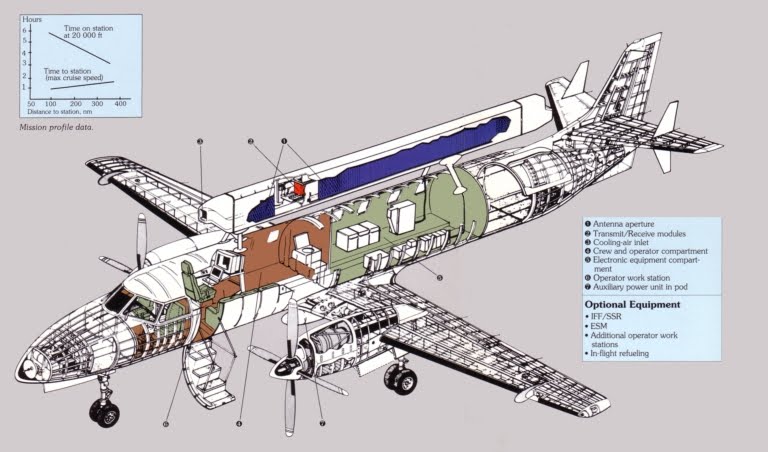
With 20 systems produced, Erieye is by far the most successful modern AEW radar on the market today.
From the Saab plant in Gothenburg, Sweden, the 20th Erieye radar system has rolled out, ready to proceed to the next phase, installation on aircraft and final testing.
“This is a milestone in the on-going production and we are proud that seven countries around the world now have selected Erieye. Although it may look the same for an unaccustomed eye on the outside, the inside is newly developed, using our spiral development process. Despite this, we have delivered on time again” says Erik Winberg, Director Product Management AirborneSurveillance.
The Erieye radar, an Airborne Early Warning radar, is the first of its kind using AESA technology. Designed for use together with regional aircraft, it is today operational on three platforms.
The multi-role radar detects and automatically tracks air and surface targets over a huge area, covering 900 km in range. It is designed to track the smallest object in the air as well on the sea surface.
The applications are both military and for national security, where the use of the system in Brazil and Mexico for anti-drug operations is one example.

SKorea deploys Firefinder radar after NKorea barrage


Seoul: South Korea said Friday it had deployed advanced weapons-tracking radar systems on islands near its disputed Yellow Sea border with North Korea following last week's artillery barrages by the North.
Defence Minister Kim Tae-Young told lawmakers the AN/TPQ-36Firefinder systems had been set up on Baengnyeong and Yeonpyeongislands.
"A few days ago, deployment of anti-artillery radar systems was completed," the minister was quoted as saying by Yonhap news agency.
The system is designed to determine where incoming artillery and rocket fire originated, to allow for a possible counter-attack.

After declaring two "no sail" zones, the communist state last weekfired 370 shells into the sea near the border over three straight days,heightening tensions on the Korean peninsula.
Seoul's military said Wednesday the North had designated another two "firing zones" in the area, effective for four days from Friday, raising the prospect of more artillery fire.
The North said its salvoes last week were part of a routine winterexercise but South Korea and the United States described them asprovocative.
The Yellow Sea border was the scene of deadly naval battles in 1999and 2002 and of a firefight last November which left a NorthKorean patrol boat in flames.

Scalable Agile Beam Radar (SABR) Tested Aboard USAF F-16

LINTHICUM, Md: Northrop Grumman Corporation, in conjunction with the U.S. Air Force, has successfully completed a series of demonstration flights of its Scalable Agile Beam Radar (SABR) installed in an F-16 fighter aircraft at Edwards Air Force Base,Calif. The demonstration was in support of a U.S. Air Force F-16Active Electronically Scanned Array (AESA) feasibility study.
"Almost two years ago Northrop Grumman said that air forces of the future will necessarily gravitate toward using AESA technology “especially through scalableretrofit technology. Our team has worked diligently to make thatpossible and today we've made it a reality. This officially marks thefirst time a retrofit AESA has ever flown in a legacy F-16," saidArlene Camp, director of Advanced F-16 Radar Programs at NorthropGrumman's Electronic Systems sector.

"This demonstration validated our goal of developing an AESA that can be easily installed on the flight lineand integrated with existing power and cooling provisions of currentlyfielded F-16s," Camp added. "With regard to installed performance,SABR's air-to-air and air-to-ground detection and tracking andSynthetic Aperture Radar (SAR) mapping performance met or exceeded ourpredictions."
SABR is an affordable and scalable AESA radar designed for retrofit in current F-16s and other legacy fighter, attack, and trainingaircraft. Compared to mechanically-scanned array radars, SABR willprovide the increased performance, multi-functionality, and greaterreliability inherent in AESA radars. In terms of combat capability,SABR provides improved situational awareness, greater detection,high-resolution SAR maps, interleaved air-to-air and air-to-surfacemode operations, and an all-environment precision strike capability.
Northrop Grumman has been the sole provider of radars for the F-16and for over 30 years has continually improved the F-16 radar'sperformance and reliability. More than 5,000 F-16 radars have beenproduced for the U.S. Air Force and 24 nations worldwide.
Because of this extensive foundation and rich F-16 heritage andplatform intimacy, Northrop Grumman is the first to design, develop,integrate, test and successfully demonstrate retrofit AESA capabilityin flight on a legacy F-16. SABR is part of Northrop Grumman's robustproduct family of multi-function sensors and capabilities.
Northrop Grumman Corporation is a leading global security companywhose 120,000 employees provide innovative systems, products, andsolutions in aerospace, electronics, information systems, shipbuildingand technical services to government and commercial customersworldwide.

E-8C Joint STARS Battle Management Role Recognized

MELBOURNE, Fla: Recent events for Northrop Grumman Corporation’sE-8C Joint Surveillance Target Attack Radar System (Joint STARS)aircraft program reinforce its contribution as the top airborne battlemanagement platform. Joint STARS is the only platform in the U.S.defense arsenal that can provide wide area surveillance covering morethan 50,000 square kilometers and detect objects moving at a widevariety of speeds.

The system’s expanded capabilities were recently demonstrated in amajor coalition exercise in Korea. Its aircrews received their sixthconsecutive battle management award. “These are significant examples ofthe system’s battle management capabilities, and illustrates itsability to adapt to the needs of the warfighter,” said Dale Burton,vice president for Intelligence, Surveillance, Reconnaissance andBattle Management Command and Control.
The versatility of the system to support more conventionaloperations was demonstrated during Ulchi Freedom Guardian 09 (UFG).This annual event is the world's largest annual computerized commandand control exercise. Retired Brig. Gen Barry Barksdale, Senior AirController for UFG, cited the Joint STARS input and crew role insuccess of the battle management exercise.
“If the opposing forces moved 100 tanks out of an undergroundfacility, it would be immediately apparent to a fighter equipped with apod that flew overhead or perhaps just a visual pickup,” GeneralBarksdale said. “In the simulation, only the Predator or the E-8C JointSTARS can provide this input in near-real time, and the Predatorrequires something to provide the cueing to narrow the look area.”
Bringing their “real world” expertise to the exercise, Barksdalenoted issues the Joint STARS crew tackled “ran the gamut from the moreobvious marshalling of air assets against emerging mobile forces,time-sensitive targeting, airspace deconfliction, targeting priorities,changing weather conditions, and countless others too numerous todetail.”
The recent award of the Air ForceAssociation’s Air Battle Management Crew of the Year to a Joint STARSteam brings to light some of their daily contributions. Each year,Joint STARS crews are considered against other systems for the awardbased on their battle management contribution to the USAF and airpower. This year’s award was the sixth in a row for a Joint STARS crewand the ninth since the award’s inception in 1998.
The 2009 winning crew from the 116th Air Control Wing was recognizedfor accomplishments including exposing weapon smuggling routes,providing overwatch for convoys and ground units and alerting them ofinsurgent advancement, relaying targets to fighters, identifyinghideouts, locating individuals planting improvised explosive device and providing target information to fighter aircraft.
Joint STARS powerful radar can track enemy combatants in all weatherconditions, day or night. Often referred to as “911 in the Sky,” theE-8C has the capability to correlate information from a wide variety ofsensors and sources to provide unprecedented situational awareness tothe combat elements on the ground.
It provides a top-down look that can track insurgents in flat areasfound in Iraq, as well as looking down in the sides of mountains andinto the valleys of Afghanistan. The ability to simultaneously trackvehicles as well as other emerging target categories in multiple areasof interest, over large areas, makes the Joint STARS system uniqueamong Intelligence, Surveillance, Reconnaissance assets.
“Yet, with all of its technological capabilities, the real warfighter value comes from the onboard Air Force and Armyoperations and intelligence specialists providing real-time battlemanagement support,” said Brig. Gen Tom Moore, commander of the 116thAir Control Wing at Robins AFB, Ga. “Our crews are trained to evaluateGround Moving Target Indicator information to identify vehicle oremerging target threats for U.S. and allied troops. They are invaluableto the entire process.”
Northrop Grumman is the prime contractor for the E-8C Joint STARSdevelopment and whole-life support programs. The Joint STARS program ismanaged by the 751st Electronic Support Group at Hanscom Air ForceBase, Mass. All 17 combat-configured Joint STARS aircraft are assignedto the Georgia Air National Guard’s 116th ACW, a “total-force blendedwing,” comprising active-duty Air Force, Army and Air National Guardpersonnel.
Northrop Grumman Corporation is a global defense and technologycompany whose 120,000 employees provide innovative systems, products,and solutions in information and services, electronics, aerospace andshipbuilding to government and commercial customers worldwide

Initial Delivery of Wedgetail Aircraft

The Defence Materiel Organisation (DMO) has today taken initial delivery of two Airborne Early Warning and Control (AEW&C) aircraft from Boeing.
AEW&C Program Manager, Air Vice Marshal Chris Deeble said the aircraft – known as ‘Wedgetail’ – is critical to Australia’s Air Combat Capability and will play a key role in achieving the Australian Defence Force’s (ADF) network-enabled war fighting capability.

“The Wedgetail aircraft is a ‘first of type’ development and extremely complex, given the range of cutting-edge radar technology and sensors that will be incorporated into each aircraft.
“Development, test and evaluation are still ongoing with manyhurdles still to be overcome, particularly with respect to radar,electronic support measures and integrated system performance and stability.
“However with the initial delivery of two aircraft, Defence will now be able to conduct familiarisation training while Boeing completes the remaining test program and acceptance activities,” AVM Deeble said.
“When fully operational, Wedgetail will enhance surveillance, air defence, fleet support and force coordination operations.”
Boeing has currently scheduled initial acceptance of the first two aircraft for the first quarter 2010 when the aircraft will come into Commonwealth ownership.
The Commonwealth will eventually acquire six Wedgetail aircraft at a cost of more than (AUS) $4 billion.
Related Posts Plugin for WordPress, Blogger...