A successful flight test of Rustom1 UAV was conducted at around 12 noon on 21st May 2011. It was the second successful flight of "Rustom 1" being developed by the Aeronautical Development Establishment (ADE), a DRDO lab engaged in pioneering R&D work in the field of aeronautics. The "Rustom 1" has an endurance of 14 hrs. and altitude ceiling of 8000 meters. Rustom 1 has been achieved by converting a manned aircraft in to a UAV (Unmanned Aerial Vehicle) by removing pilot seat and making required electrical, mechanical and aerodynamic modifications.
The test flight was conducted at the airfield belonging to the M/s Taneja Aerospace (TAAL) located near Hosur. Many improvements have been carried outs since the last flight, in terms of piloting, landing, taxiing etc. The flight was a precursor to the flight with payloads as required by the Services. The complete sequence of events went off well to the total satisfaction of the scientists and technical personnel of the Bangalore's Aeronautical Development Establishment who have developed the UAV. Lt Col Thappa from the Army was the external pilot for total mission flight who had no difficulty for control of the vehicle.
After launching development of stealth UCAVs (unmanned combat aerial vehicles), India is now also looking at designing solar-powered spy drones which can cruise in the sky for several days at a time.
The high-altitude, long endurance (HALE) solar-powered UAV will not just reduce Indian military's carbon footprint but more importantly provide a cost-effective and flexible 24x7 ISTAR (intelligence, surveillance, target acquisition and reconnaissance) platform akin to "a pseudo-satellite" orbiting closer to the ground.
"Yes, Army and IAF have asked us to develop the solar-powered HALE UAV. Initial work is in progress for such a drone which can undertake a 15-day continuous flight over 30,000-feet," DRDO's chief controller R&D (aeronautics) Dr Prahlada Said.
India's navy has operational requirements for additional unmanned air vehicles made by Israel Aerospace Industries, sources say, with these to potentially include improved Heron or Heron-TP systems carrying maritime sensor payloads. Evaluations using some systems have already been carried out, they add.
The Indian navy in January stood up its second UAV squadron, with its current IAI-produced Heron and Searcher II systems facing increased operational demand. This has led to indications within recent weeks that additional contracts could be placed with IAI, the sources say.
In addition to having already provided UAVs to the Indian navy, IAI is also equipping the service with additional equipment, such as the Barak-8 air defence missile.
India has filed an RFI (request for information) for a small vertical take-off and landing UAV (unmanned air vehicle).
The Indian Air Force’s request is for a battery or fuel-operated UAV that weights less than 10Kg and can fly for more than 60 minutes.
The UAV will be used for search, reconnaissance and intelligence missions. Payloads will include forward-looking infrared and laser spotters, cameras and rangefinders. The RFI specifies that the UAV must be able to hover and operate in urban environments. Portable and light-weight ground stations must be provided with the system.
Elbit Systems says it has successfully flight-tested its Hermes 450 and Hermes 900 unmanned aerial vehicles from one ground control station, greatly enhancing the operational flexibility of the long-range drones amid a growing global market for the aircraft.
The tests underlined how Israel's high-tech defense industry is developing a wide range of unmanned robot systems for air, land and sea. These include Nahshson, a remote-controlled land vehicle that can tote 2 tons of cargo.
This is an advanced variant of the Guardium robot vehicle developed by G-NIUS Unmanned Ground Systems, a joint venture by Elbit and state-owned Israel Aerospace Industries. The Guardium has been in operated by the Israeli military since 2008.
Elbit said the Hermes tests were conducted from the company's new universal ground control station using a single operator for both UAVs. "Joint flight control and management of two different unmanned aircraft systems provides users with enhanced operational flexibility, adapting each UAS to a specific mission and enabling management of highly complex missions in diverse arenas," Elbit said.
The Hermes 450 is a tactical long-endurance UAV that is the backbone of the Israeli air force's drone fleet, with more than 200,000 operational flight hours.
It's capable of flying at altitudes up to 20,000 feet. The latest variant is quieter than its predecessors and carries a heavier payload. The Hermes 900 has longer endurance, a silenced engine, a maximum altitude of 30,000 feet and a larger payload capacity of 770 pounds. Israel's defense industry has become a major producer of UAVs, along with the United States.
According to Jacques Chemia, chief engineer of IAI's UAV division, "Israel is the world's leading exporter of drones, with more than 1,000 sold in 42 countries."
Under a ground-breaking April 2009 contract with Moscow, worth $53 million, IAI, flagship of Israel's defense industry, sold Russia 12 short-range Bird-Eye 400, I-View MK150 and long-range Searcher II UAVs.
It was Russia's first purchase of a foreign weapons system and emphasized its technology shortfall following the sharp reduction of spending on research and development in the 1990s when the Cold War ended. That contract led to a $400 million deal between IAI and Russia's Oboronprom OPK Group in October under which the Russians will eventually manufacture the Heron 1, one of Israel's most advanced UAVs capable of strategic missions.
IAI has developed the more advanced Heron TP, dubbed the Eitan which is Hebrew for "Strong."
This long-range UAV weight 4.5 tons, has a wingspan of 86 feet -- about that same as a Boeing 737 airliner -- and can stay aloft for 20 hours at high altitude.
This unique UAV, a major technological breakthrough for the Israelis, has a 1,200 horsepower turbojet, a maximum altitude of 40,000 feet and can carry hundreds of pounds of equipment, such as high-resolution cameras, electronic surveillance systems and presumably weapons.
The Heron TP is capable of reaching Iran, although it's not known whether it has done so on surveillance missions, or whether it can be refueled in air. The Hermes 900 is also reported to be able to reach Iran. The ground-based robot systems are now widely deployed with the Israeli military. The Guardium has notched up thousands of operational hours since 2008.
The Nahshon, the latest UGV being developed by UGS, is able to operate on its own in combat zones. The Nahshon team believes it is close to producing a completely autonomous guidance system for the cargo vehicle. Guardium and other UGVs are used to reinforce the remote-controlled gun and sensor towers or patrol areas along Israel's borders with troubled Lebanon and the Gaza Strip.
Amid the upheaval in Egypt that toppled President Hosni Mubarak, Israeli Prime Minister Binyamin Netanyahu ordered the construction of a security barrier along a 90-mile stretch of the border with Egypt to be speeded up. This, originally intended to keep out illegal African immigrants, could have remote-control guard towers as well and be patrolled by UGVs. Over recent years, the Israeli military has automated much of its security along the Lebanese and Gaza borders.
This includes the Sentry-Tech armored watchtowers, 15 feet high and 6 feet in diameter, that are topped with remote-control machine gun turrets and night-vision video cameras. The latest addition is radar that can penetrate fog.
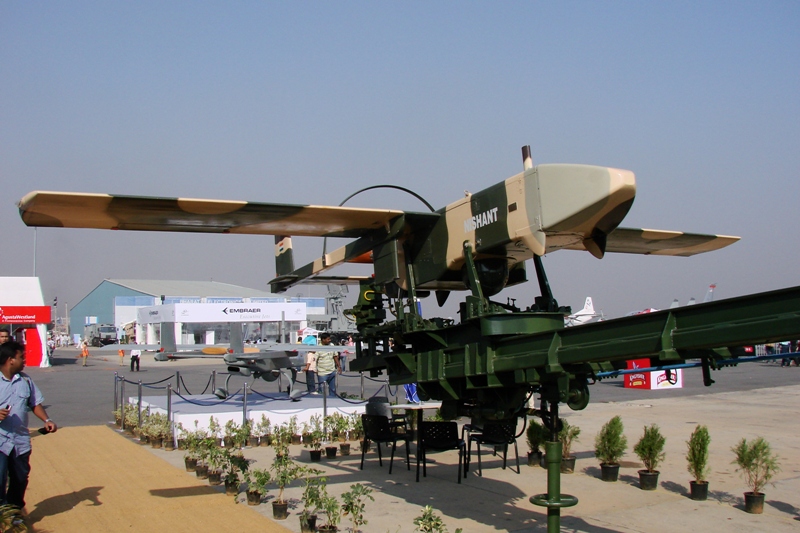
After completing successful flight trials in Rajasthan, Indian Army recently took delivery of four indigenously designed and developed 'Nishant' Unmanned Aerial Vehicles (UAV).
"Nishant has successfully completed the series of confirmatory trials conducted by the Indian Army at Chandan Range in Pokharan recently before (the Army) taking delivery of a set of four UAVs together with ground systems," DRDO officials said here.
To be used for battle-field reconnaissance in day and night, surveillance, target tracking and correction of artillery fire, the DRDO-developed UAV can also be utilised for anti-insurgency operations.
The electro optical, electronic intelligence and communication intelligence payload on-board the UAV make it suitable for a range of operations both during wartime and counter insurgency operations, they said.
The Nishant is capable of being launched from a hydro pneumatic launcher, without the need of a runway. The UAV can be controlled by 'Ground Control Systems' mounted on Tatra vehicles, DRDO distinguished scientist Prahlada said.
With an endurance level of four and a half hours, Nishant is designed for safe recovery from a desired place with the help of parachutes.
Along with the regiments which would be operating the UAVs, the confirmatory flight of the UAV were witnessed by the Director General of artillery Lt General Vinod Nayanar and Director of Aeronautical Development Agency P S Krishnan.
Nishant has been designed and developed by DRDO's Aeronautical Development Establishment (ADE), which specialises in developing UAVs, flight control systems and simulators in association with other labs.
Turkey’s first national MALE-class (medium altitude long endurance) unmanned aerial vehicle, dubbed “Anka” after an Anatolian bird, made its maiden flight without much of a publicity just before the New Year’s Day, TRDEFENCE sources reported on Sunday.
Anka is vastly superior to its competition (such as the Heron of Israeli origin) in the same category thanks to its heavier payload capacity, long flight time of 24 hours, higher flight ceiling and state-of-the-art electrooptical instruments that include Aselsan’s next-generation AselFLIR 300T, laser target designator and an indigenously developed synthetic aperture radar (SAR) that can detect, identify and track targets day and night, beyond thick layers of cloud, dust and smoke.
Anka also carries on-board artificial intelligence that enables the aircraft to fly autonomously without the requirement for remote human assistance, find allied airbases in the event of an emergency and land automatically.
An armed version of the aircraft, codenamed Anka-B, is currently under development in Turkish Aerospace Industries (TAI) with further funding from Turkey’s Undersecretariat for Defence Industries, SSM. Reports indicate that Anka-B’s modular weapons architecture will be able to carry Roketsan-developed Cirit laser guided rockets, UMTAS anti-tank missiles and/or other compatible weapon systems depending on the assigned mission.
Anka features low radar observatibility courtesy of its thin profile, carbon composite structures that minimize the usage of highly reflective metal components as well as its aerodynamically efficient design.
The first Anka is expected to be commissioned by TurAF in 2011 with the armed Anka-B following it up in 2013.
The Indian Air Force is projected to induct a large number of 5th generation fighter aircraft within the timeframe of 2025. This poses serious challenges for the numerically smaller Pakistan Air Force (PAF). The paper suggests UCAVs as a possible solution in countering India’s military aviation threat to Pakistan. Pakistan can develop UCAVs in the same manner they developed the JF-17. The argument is in favor of UCAVs to supplement 4th generation fighters and enumerates an active and specific solution for PAF. Introduction:
Unmanned Combat Air Vehicles (UCAVs) are a category of Unmanned Aerial Vehicles (UAVs) that are designed to fire munitions and are characterized by increased autonomy of operation. Key attributes coupled with UCAVs, as defined in conventional military jargon, include an unmanned counterpart of a manned attack or fighter aircraft. This necessitates such capabilities as range, high speeds and a significant weapon load. Another key salient of UCAVs is the broad requirement for UCAVs to survive engagements rather than be used in one-way kamikaze strikes. UCAVs operational today are largely restricted to small, lightly armed derivatives of more conventional UAVs.[1]
UCAVs are an emerging technology that has the potential to revolutionize air warfare. While the 5th generation of combat planes today is the pinnacle of military aviation, UCAVs present paradigms that can supplement if not supplant them. Subject Matter Experts (SMEs) who discuss a potential 6th generation inevitably mention unmanned aircraft as a possible key salient.[2]
This paper focuses on UCAVs in a function as air-to-air combat vehicles focused on air superiority missions. The paper is in exclusion of other roles such as air-to-ground and Intelligence, Surveillance & Reconnaissance (ISR). It is recognized that UAVs are highly effective in both these roles and this exclusion in no way implies the belittlement of these key aspects to UCAV and UAV technology.
The paper considers the advantages, disadvantages, technology and politics and how this relates to Pakistan and her threat perception. It offers a specific solution tailored for the Subcontinent.
The Advantages of UCAVs
Long Range Beyond Visual Range Air-to-Air Combat
The world is increasingly converging towards long range air-to-air combat, not only with increasingly sophisticated radars[3] that negate stealth[4], but also AAMs like the ASRAAM and the A-Darter that provide an improvement in range of IR-based missiles (Defense Industry Daily, 2010). Pilots engaged in BVR combat perhaps have the least value added to combat; essentially, they monitor their sensor-suite, communicate with controllers and then fire a missile which then takes over the task of actually destroying the target. An F-pole style maneuver or other similar maneuvers are limited by the G-forces that the pilots can sustain. Dodging incoming BVR missiles, fired from enemy aircraft is again limited by the G-forces the pilot can handle. The case for a UCAV in this form of combat is arguably the strongest after ISR.
Short Range within Visual Range Combat:
To consider WVR combat, let us visualize what is achievable with the state-of-the-art at present in the form of the F-35. We will later consider how much better a UCAV can exploit these advantages than a manned pilot.
In a post-merge scenario where a large number of friendly and enemy aircraft are embroiled in a dogfight, identifying friend-or-foe and firing at a target can become both critical and yet complicated. When a fraction of a second counts, the human pilot has to analyze his MMI and make a quick choice. The F-35 helps this critical process by providing an MMI that keeps track of all aircraft embroiled in the fight and displaying them in the most user-friendly method possible.
The process sounds difficult, but is only so for a human. A computer can analyze aircraft shapes easily. Situational awareness, whether human or computer-enabled, allows a fighter aircraft to assign missiles for targets as soon as a picture of the battle-space has been formed. With HOBS missiles, the execution is relatively simple even for a less maneuverable combat aircraft.
Another element added by the F-35 is interconnectivity or swarm logic. Once situational awareness has been achieved by man or machine and the fighter aircraft knows where the friends or foes are, and at the same time can communicate with the rest of the friendly fighter aircraft who also share the same picture of the battle-space, computers can execute complex plays in a team format. This creates a veritable soccer match were one side knows exactly what is going on in the entire football field and the location of its players. As a result, they can significantly outplay the opposing team. Such strategies may include providing cover fire, cross fires, gambits and other game-theory based plays[5]. All such maneuvers can take place pre-programmed and at speeds, G-forces and time frames not possible by human operators. Swarm tactics have already been demonstrated by US aircraft manufacturers in their UCAV programs (Jaquish, 2004).
Can a human operator compete? Kasparov may or may not be able to beat Deep Blue on a given day. However, to do so while sitting in a fighter cockpit, facing G-forces and in the time constraint of fractions of a second, the victor becomes all too obvious.
Human operators can always be put in the loop where necessary, but a UCAV can easily handle many tasks autonomously, and like an attack dog, only need to be pointed at the enemy. The UCAV can take off, fly a designated route, destroy targets and awaiting instruction or flying back to base, dodging missiles and being fully aware of many factors pilots often forget – being aware of status of weapons, fuel supply, location of enemies and friendly forces, ground units and whether weapons doors are open or closed. It can think of all this simultaneously and do so without mistakes, under any amount of stress, either physical or sensory.
Low Costs:
UCAVs can be manufactured and operated at a tiny fraction of the cost of manned fighters. Quality pilots are a rare commodity and are hard to find, train and keep operationally ready. They also take a considerable amount of lead-time to train effectively. Another aspect is the low maintenance and operational costs due to not having a requirement to constantly fly aircraft. This also means that many important systems do not need to be as reliable or have high MTBF (Mean Time Before Failure). After all, if the UCAV is not endangering a pilot’s life, does not fly frequently and is cheap to manufacture, they need not be as durable. UCAVs need only be flown during wartime or during high tension periods.
This means that their subsystems can be built more cheaply, a key cost element particularly in combat aircraft engine technology. However, some caution needs to be placed as to how far reliability can be compromised as this can be a double-edged sword with accidents and mishaps also effecting costs (Lewis, 2002).
UCAVs may also be cheaper because many expensive elements in a modern fighter relate to the pilot. For instance, cockpit glass is an exceedingly expensive item. Ejection seats, life support systems, cockpit avionics and targeting systems and the sheer space, bulk and weight savings all go to make UCAVs significantly cheaper than manned alternatives[6].
Due to modern network centric warfare, not all UCAVs need have sensors. Expensive AESA radars for instance can be avoided in but a few aircraft within a “pack”. These can often be a manned fighter that orchestrates the package, perhaps preferably a twin-seater, or even be managed by ground controllers / radars or airborne AWACS.
A small UCAV built from an existing parts bin of spare parts can lower costs significantly. We shall discuss further about this aspect later in the paper.
Quantity versus Quality:
Most nations including the United States and China are increasingly fielding sharply smaller quantities of later generation fighters because of the cost and complexity. UCAVs can be produced cheaply, at a small fraction of the cost of modern fighters and can be mass produced for war. As Joseph Stalin once said, quantity has a quality all its own. As modern 5th generation aircraft increasingly resemble flying Tiger tanks, a cheap, simple solution may just prove be the equivalent T-34 equivalent in modern warfare.
Kamikaze:
UCAVs can go into combat disregarding whether they need to come back or not. While fighter pilots may have similar patriotism, operationally air forces for moral and morale reasons prefer to have an exit strategy unless in the most extreme of circumstances. UCAVs make kamikaze strategies practical not only during desperate phases of the war but viable from Day 1. In BVR combat, this becomes an interesting aspect as there is always a tradeoff between the distance a fighter shoots its missile from (and thus how effective this shot will be), and how likely the plane is to come back intact.
This proposition is even more tenable because UCAVs may prove to be significantly cheaper than their manned enemies and the tradeoff would favor the UCAV operator. Most vitally, UCAVs employing such tactics would have a drastic impact on the enemy’s psychology. The Rand Corporation expresses this doctrine best in the following words:
Aerospace power will tend to perform best when the desired outcome involves affecting adversary behavior rather than seizing and holding terrain. -RAND Corporation
The Disadvantages of UCAVs
Tackling the Problem of Jamming:
One of the first responses to proposals for UCAVs is whether they will be able to communicate in the event of jamming by the enemy. When we discuss UCAVs, we often have the image of a Predator operator sitting in some trailer guiding the plane and wonder what would happen to the Predator if that link was lost. The first element to consider is that today’s Air-to-Ground based UAVs such as the Predator need a high proportion of the human element because of the vagaries of today’s COIN and CAS operations. High bandwidth data transfer such as video streaming is assumed to be an integral part of UAV operation. This does not have to be true for UCAVs. Identifying friend-or-foe can be significantly easier in an air-to-air battle, particularly with mature IFF technologies. This is true particularly in a Pakistan-India scenario, where the direction of enemy inbound fighters is well known and the environment is best described as sensor rich.
The end result is that, a highly autonomous UCAV will not need constant connectivity but will need to be assigned a task and given instructions for post-task completion. For instance, if after destroying enemy aircraft no other enemy aircraft are found in the vicinity and no instructions are forthcoming from friendly forces, the UCAV may simply be programmed to return to base. In case of fear of electronic warfare incapacitating or overriding the UCAV, a controller may pre-program the UCAV to not accept signals from a specified time period forward. To accomplish the given mission and either go back to base or move to a specific geographical area deep inside Pakistani territory and receive specific directional signals for further instructions.
In this scenario, a UCAV can still be jammed from being operationally effective, but manned aircraft will suffer to the same extent as the UCAV. Even a 5th generation aircraft without AWACS or other auxiliary support will be vulnerable. Another point is that modern communications, even Link 16 is exceedingly hard to jam. Directional communication links are also increasingly mature and near ideal for UCAV use.
Human Element:
Despite all the advantages of a UCAV, the human element cannot be fully substituted, whether one with Artificial Intelligence (AI-UCAV) or a more conventional model. There will always be an opportunity for a fighter pilot to think outside the box. This will continue to remain a weakness of UCAVs. Carlo Kopp mentions the two ideological extremes in UCAV literature, one looking at UCAVs as a “dumb RPV” while the other trying to build a James Cameron’s “Terminator” and suggests a moderate approach between them may be most appropriate (Kopp, 2001).
Reasons Why the West is Being Held Back
Their Politics:
Many technology choices made by the United States and her allies are not based on merit alone but are made because of political reasons. USAF officers for instance, would not like UAVs to take over jobs of their pilots. An example is the Congressional deadline for the USAF to field a third of its force as UAVs by 2010 (Jaquish, 2004). The USAF considered a Predator that can fire its own missile a bad idea and this was not overturned until the CIA used them with great success. Even when forced to fly UAVs, they have insisted on using pilots to fly the UAVs. The US Army proved otherwise when they began using NCOs instead. Another glaring example of the organizational hubris of the US armed services is in their Joint Vision 2020. There is not one mention of UAVs or UCAVs, nor a single picture of one in a paper that has over 50 images of tanks, submarines, fighter jets, warships, transports and refugee camps[7]. William Lewis (Lewis, 2002) also complains about the long lead times in acquisition and procurement within the US armed services.
This bias in the USAF and perhaps in other Western air forces is a key reason for why UAVs in general and UCAVs in particular, have not made breakthroughs in the scale anticipated with technologies now available. History has shown that it often takes a major shock in the form of a war to change perceptions, as was seen in WWI, WWII and to a lesser extent the subsequent wars up to Gulf War II. What we do know is that the people closest to knowing the feasibility of technology in building operational UCAVs are putting their money in this technology. Boeing, Northrop Grumman and General Atomics have spent their own hard cash in researching and developing new UCAVs without formal requests or interest from the USAF.
The Technology behind UCAVs
The technology for fielding real UCAVs has many critical areas that are already proven and mature. Many of the technologies are in fact only waiting to be integrated together. Consider the example of autopilot computers that can now takeoff, fly to a destination and land a commercial aircraft. This technology is operational in the commercial airline industry and is considered mature today. Pilots can merely take control when something untoward happens and requires out-of-the-box thinking.
An American Global Hawk today can take off, fly around the world, accomplish its ISR mission and come back to base making a perfect landing, with no manual input. A JSF is being designed with the ability to visually track a large number of targets, identify and categorize them without any human input. Modern missiles can defeat maneuvering fighters by employing multiple tactics, even being able to come back in case it missed the designated aircraft in its first pass. Again, all this is accomplished without input from a human.
Diffusion of Technology Worldwide:
The technology to build manned fighter aircraft has traditionally remained within a handful of nations such as Russia, USA, China, France, Sweden and the United Kingdom. This monopoly of technology has been a major issue particularly vis-à-vis the West and the Rest of the World. UAV and UCAV technology on the other hand, has been far more diffused throughout the world. Smaller countries and countries with little previous record of aircraft manufacture, such as Israel, Austria, Italy, Spain, Belgium, Switzerland, Turkey, among others are making significant contributions. For instance, Camcopter, a product by a small, hitherto unknown Austrian company Siebel, has sold a large number of its UAVs including over 80 to the UAE (Wezeman, 2007). What is even more interesting is that a number of parts will be manufactured by such an unknown as the UAE Research and Technology Center. It may also be noted that even within the US military-industrial complex, it is General Atomics as opposed to Boeing or Lockheed Martin that has stolen the lead. From these examples and a number of others, the technology behind UCAVs is realizable by firms outside of the traditional countries and corporations that had earlier dominated military aviation. The UAV industry is by all indications Schumpeterian and remains wide open to any country or company.
Golden Opportunity to Pull Ahead:
If the Pakistan Air Force can do better and avoid institutional and political barriers that the West is plagued with, they can make a relative leap in capabilities and meet their goals and objectives far better than a linear and asymmetric solution could. Pakistan has achieved a significant milestone with the JF-17. With a UCAV, Pakistan will have achieved the next major milestone. Pakistan’s aircraft manufacturing industry would remain relevant rather than become outdated and relegated to obsolescence. Pakistan does not have the technology or the resources to build an expensive and complex 5th generation plane. A UCAV however, is a far more achievable goal. As we shall see later, the technologies involved allow far greater flexibility and can be said almost ideally suited to Pakistan’s military-industrial complex’s strengths.
Pakistan’s Threat Scenario 2025
Before considering an active solution and the technologies relevant to that solution, it may be helpful to first consider the threat scenario for Pakistan. A 15 year forward plan may be relevant to our discussion. This is based on the perceived change in the quality of the threat in Pakistan’s neighborhood in that timeframe and allocates time to field a response for Pakistan’s aeronautical industries.
India will begin to field PAKFA fighter jets from Russia and may also develop her own from technology bought from the Russians. While the latter may be discounted as another employment opportunity for DRDO and related third-rate Indian bureaucracies, PAKFA and any specific design built for India by the Russians will provide a challenge that would be wholly new to the subcontinent: a 5th generation fighter. Further, it may not be farfetched to imagine a JSF purchase for the IAF, given the blossoming long-term partnership developing between India and the United States.
While the credentials for the JSF are still unclear and the jury may be out on its air-to-air combat capabilities, the PAKFA is a clear threat. The PAKFA was designed to counter the F-22 in air combat. The threat is perhaps best defined as reasonable stealth, super cruise, high altitude and high speed. The PAKFA takes BVR combat to a new level that the airframe of the JF-17, by design, cannot compete with. BVR missiles launched from a high-high profile aids missile range and speed, and reduces the threat, range and effectiveness of Pakistani BVR launches in response. With AWACs and refuelers in the sky, such threats would be a menace, particularly with longer ranged BVR missiles from Russia.
A major political and geo-strategic to consider is the War on Terror (WOT) in Afghanistan may be winding down by then and aid from the United States and other Western countries are likely to dry up. Pakistan’s Afghanistan leverage vis-à-vis the international community could be drastically reduced. In a worst case scenario, sanctions may once again be imposed in one form or another.
By 2025, India could field PAKFAs and perhaps even JSFs in the hundreds, drastically changing the military balance in the Subcontinent. Pakistan can either go bankrupt attempting to counter this new threat or she can become obsolete, back to a decade similar to the 1990s. Or Pakistan can develop UCAVs.
In the next section of this paper we consider UCAVs as a solution to Pakistan’s air defense needs.
Possible UCAV solutions for Future Air Combat
Establishing a requirement first requires the establishment of a doctrine. This is a critical weakness for the European Union were divergent needs are hard to align and researchers often have to work on the basis of practicality (Freitas, et al., 2009). As concerns PAF, there is a clear threat scenario and easier possibilities of establishing a doctrine. Based on an outlined doctrine, we can consider a number of possible UCAV solutions for the PAF in tackling the future threat scenario of an Indian PAKFA and other possible 5th generation aircraft.
Let us start with a quick recap of possible strategies. The general approach has been to counter India’s provocative procurements on a largely symmetric basis. Increasing number of manned fighter jets have been reciprocated by increases in Pakistan’s inventory of manned jets. Purchase of AEW assets have been matched by an equivalent purchase. Nuclear tests were responded to with equivalent nuclear tests as were ballistic missile tests. However, this asymmetry is increasingly impractical because of differing size and economic development between the two countries.
Meanwhile, India is now slated to acquire a large number of 5th generation planes in a 50-50 partnership with the Russians. Instead of attempting to break the bank and procure increasingly complex (and expensive) 5th generation fighters with the added exponential increase in maintenance and other operational costs, a solution may be to respond asymmetrically.
Two possible scenarios appear within a broad asymmetric strategy – positive asymmetry or negative asymmetry. Examples of implementing a negative asymmetric scenario against an IAF fielding significant numbers of 5th generation fighters would be to push back defenses further away from the border, rely more on LR-SAMs and resort to hardening major assets against the inevitable.
A strategy of positive asymmetry is also possible. This would imply responding asymmetrically but in a more proactive, aggressive and positive manner. This paper will outline such a strategy. As an example of such a strategy, Pakistan can choose to skip the 5th generation concepts and move towards combining the most practical of the 3rd, 4th and 5th generation with concepts deriving from the 6th generation; a simplified UCAV to supplement PAF’s 4+ generation fighters. This approach will not be unique. Japan for instance, may choose to skip the 5th Generation concept with its i3 fighter concept (Perrett, 2010).
A Practical UCAV for Pakistan
The attempt forward will be to propose a solution in the form of a UCAV for the PAF. We will first focus on some basic parameters that need to be fulfilled. The focus will then shift to defining a specific solution that meets those requirements in a most balanced manner.
We identify the following characteristics as imperative for the discussed UCAV solution:
1. Unmanned Platform 2. Simple construction and achievable technology 3. Simplified single-engine buildable in Pakistan 4. Relatively Low Cost 5. Economy and asymmetry in sensor load 6. Using parts bin of existing aircraft and from industry partners 7. Designed for high altitude, high speed f-pole BVR combat 8. Structure can operate in and sustain high G-forces 9. Artificial Intelligence 10. Network centric 11. Swarm & Group Tactics 12. Low Observable 13. Combat Air Patrol efficiency 14. Interceptor suitability
A specific solution to fulfill the above requirements is investigated next. For purposes of this paper, the designation used will be J-UCAV or Joint UCAV, assuming a partnership at least with China, if not with other countries such as Turkey, Malaysia, Saudi Arabia, UAE, South Africa, Brazil, Argentina, Iran, Italy, and more. The proposed solution is in the form of a well-swept delta, single-engine UCAV.
The X-47 Pegasus is a design that broadly appears suitable for Pakistan’s requirements. The design features a simple, single engine, well-swept, diamond-shaped delta. The large delta provides low wing-loading, ideal for high altitude flight and maneuverability. The high sweep mitigates the delta’s drag, allowing a classic high-high aerodynamic profile to counter the PAKFA. Inherent structural integrity of the diamond-shape delta simplifies construction and allows the design to be strengthened for high G-forces at a smaller weight and cost penalty.
While a tailless design appears most efficient in terms of drag and RCS, developing a maneuverable fighter may prove problematic and high-risk from the perspective of keeping the project within the meager budget and time constraint of the PAF. A proportionately small twin tail is proposed instead (not illustrated). This twin tail may or may not be supplemented by thrust vectoring. Developmentally, this suggests a safer choice and allows greater control authority.
A single engine solution is proposed for the J-UCAV to be cost effective in acquisition and maintenance. As discussed earlier, since UCAVs do not need to fly frequently because of pilot training requirements and has to maintain a simple, cost effective solution. Simplicity of design and manufacture is important since the J-UCAV must be built in, and afforded by Pakistan.
The J-UCAV design proposed in this paper makes the hypothetical assumption of using an RD-93 or a WS-13 / WS-12 size engine. Taking a standard fighter aircraft engine as the benchmark can help allow the program to use the engine parts bin of an existing system. Assuming the stringent requirements for metallurgy, advanced composites and other advanced materials and manufacture processes can be relaxed, degraded or substituted to an extent, the UCAV engine can then perform adequately in the same thrust range with the tradeoff of degraded MTBF and reliability in lieu of low cost and simplicity.
A problem faced by a high-sweep delta design is poor CAP performance. This problem exists because of higher cruise speed as a result of sweep and greater drag because of delta wings. The solution proposed thus compromises our CAP requirements. To alleviate this issue and allow the J-UCAV better CAP performance, one possible solution is using non-movable, disposable canards. The reasoning behind such a solution is explainable as a fighter does not need to pull high Gs while on CAP, nor does it need to fly particularly fast. In fact, the slower and higher it can fly the better. Such flight profiles allow a balanced tradeoff between fuel efficiency and endurance, on the one hand, and potential kinetic energy from the high altitude profile. Adding high aspect ratio disposable canards can help slow and high flight profiles. In case of a threat, the fighter can dispose its canards in-flight and engage.
The diagram indicates possible locations for such canards. The canards may be added to the wing tips and / or forward of the wings. In the latter case, one anticipated issue is of clearance during disposal; avoiding the disposed canards from hitting the airframe. Some possible solutions are listed below:
1. Having an ejector mechanism that pushes the canards away from the airframe. 2. Building the forward disposable canards with light composite material and coating them with softer material to avoid damage in case of accidental collision. 3. Carefully planning disposal flight profile. For instance, a high angle-of-attack release profile, particularly possible with thrust vectoring, may allow seamless separation.
DSI intakes may also be incorporated to decrease RCS, increase performance, and reduce weight and costs. A possible improvement to DSI intake design that PAF, PAC Kamra and Chengdu engineers can look into may be a variable DSI. At first glance, this sounds contradictory given that DSI intakes are meant to supplant variable intake designs. However, a DSI bump that can enlarge or contract using pneumatic, hydraulic or other mechanisms can improve flight performance in a wide variety of flight profiles. These can possibly be significantly cheaper and lighter than more traditional variable inlet designs and simultaneously be stealthier. However, given Pakistan’s budget constraints, any J-UCAV program should not be stalled because of risky technology choices and men better qualified than this author can perhaps decide better whether to pursue such technologies.
Using off-the-shelf parts from existing platforms can reduce such development risks further and reduce costs and time. The F-117 program is testament to the usefulness of this strategy. The approach can be extended to the maximum possible parts from the JF-17 and Chinese combat aircraft, UAVs and UCAVs. A UCAV designed around an RD-93-class engine can possibly use a large number of subsystems from the JF-17; the landing gear is a possible example.
Other technology choices for the J-UCAV may include a 360 degree sensor suite similar to the F-35 and asymmetric sensor payloads. The latter implies that only a portion of the UCAVs / manned aircraft in a pack will have expensive systems such as AESA radars installed. Others will be more dispensable missile careers. This strategy is sometimes referred to as cloud shooting (Perrett, 2010) and is similar in concept to naval engagements. The Japanese concept is illustrated and shows relevance to our strategy with the exception that instead of 6th generation manned fighters guiding UCAV swarms, 4th generation fighters available to PAF may provide the equivalent UCAV guidance authority.
Given the ability today of remotely launching AAMs and the highly sensor rich environment over Pakistani air space in the time-frame of deployment, such auxiliaries would provide cheap force multipliers for Pakistan. There is some discussion among observers that at least some of PAF’s Mirage and F-7 fleets have been upgraded in a similar manner to launch BVR missiles using input from external sensors through the C4I network. While there is doubt about the feasibility and usefulness of maintaining older jets in this role with due consideration to pilot training and maintenance costs, J-UCAVs would provide ideal substitutes and appear to be perfect platforms for this role.
In the Grande Strategic view, PAF can use large numbers of J-UCAVs as a cheap and ideal counter for IAF and any other air force that seeks to undermine Pakistani airspace. They could form a picket line that are the first to deal with enemies and are reinforced with manned fighters where necessary. Such J-UCAVs would require very low maintenance, near zero training costs and may be cheap enough to not worry about being put outside hardened shelters, a valued commodity for PAF. Armed with 2 BVRs and 2 WVRs, J-UCAVs could prove to become the foot soldier of the skies, lightly armed and yet overwhelming in their numbers. In Conclusion
UCAVs are an emerging technology that has the potential to revolutionize air warfare. While the 5th generation of combat planes is today the pinnacle of military aviation, UCAVs present paradigms that can supplement if not supplant manned fighters of the 4th and 5th generations. People who discuss a potential 6th generation inevitably mention unmanned aircraft as a likely salient. Unlike the 5th generation of aircraft that are extremely expensive and complex to build and maintain UCAVs provide the potential of finding an equivalent solution with significant reduction in complexity and cost.
The PAF has until now not considered UCAVs in the air-to-air role. With the systematic addition of net-centric warfare with platforms such as Erieye, ZDK03, ground radars, future planned communication satellite and the necessary middleware for a superior C4I, Pakistan has managed to transform the battle environment to one were UCAVS can multiply the effectiveness and flexibility of the entire air defense system.
While nations struggle to keep their 4th generation aircraft operational and can barely dream about 5th generation solutions, UCAVs provide an interesting paradigm shift that cannot be ignored by those entrusted with the defense of their nations and peoples. For some like Pakistan, UCAVs may be the only realistic way to counter a large number of PAKFAs and possibly other 5th generation planes sitting across the border in belligerent India, whose stalwarts dream about “cold starts” and “surgical strikes”, and are only kept at bay by the strength of arms and the courage of the Pakistani soldier; whether on land, in the depths of the seas, or up high over the towering mountains and skies above.
In the next decade all Air Forces are focusing on the Stealth Technology available in the 5th Gen aircraft. The IAF burnt by colossal failures with reference to indigenous aircraft and engine manufacturing was left with a huge gap. It has tried to fill the void which was left by the inability of the IAF to produce the LCA. That void is being filled by three level of purchases, the MCRC, the purchase of Russian PAKFA (called FGFA in Bharat) and possible direct purchase of aircraft from the US.
Within the next quarter century, the IAF is projected to have many 5th generation fighter aircraft. The Chinese Ari Force is Light Years ahead and faces no threat from Delhi. The PAF has taken note of the IAF numbers and is taking appropriate measures to deal with the situation.
The IAF in 2025 will have the PAKFA in service, provided the Russians can produce the aircraft and provided that they are not another generation of Flying Coffins.
The PAF Countermeasures are as follows:
Begin the slow progress of mastering the technology so that it can be inculcated into existing Aircraft.
Jointly design and build Aircraft with China with approach 5th generation and beyond.
Purchase US aircraft with a bit older technology, and then upgrade those aircraft at lesser cost.
Work with Indonesia, and Turkey in developing local military technologies to counter the threats.
Use less expensive ways to deal with the incoming threat.
Bank on Missiles to counter the threat.
Bring incremental improvement to the JF-17 Thunder in Blcoks of fifty. This will keep the JF-17 thunder infused the latest technology for the next fifty years.
Start production of the FC-20s based on the J-10B and work with the Chinese on the production of the J-11s.
Enhance the UAV technology to the next level and design and produce Unmanned Combat Air Vehicles (UCAVs),
One expensive option is to build X-47 Pegasus class, to counter India’s military aviation threat to Pakistan.
Work with the Chinese to jontly build the WS-13 engine so that it can be used on the UCAV’s.
Continue development of the Babur Cruise missile and use to to build UCAV’s.
This mixture of response will not only be a potent defense against the IAF, but it will be eliminate the attempt of the IAF to intimidate Pakistan.
The first UCAV’s were autonomous cruise missiles, something that the U.S. and Germany have been fielding since the 1940′s. In Europe, several UCAV’s are known as robotic warplanes ( the Neuron, the Barrakuda and the Corax) are under development. These UACV concepts had their origins in the US, and Europe wants to remain competitive with the American Aviation industry. All the programs have stealth features playing in the same league as the American J-UCAS (Joint Unmanned Combat Aerial System). The US program includes the Boeing X45C and the Northrop Grumman X47B Pegasus . These European projects are the first foreign competitors for the American UCAV.
These major UCAV’ systems are in play:
The six nation $480 million European effort has a produced a flying prototype.
The joint German-Spanish, Swiss, Barrakuda conducted its first taxi tests on the 26 January 2006.
The British Corax UACV. The UK perceives the Joint Strike Fighter as the last manned platform for its Air Force, which will eventually replaced by an UCAV. The Corax, which undertook its maiden flight already in 2004.
China is making UCAV by adopting the old F-7 designs. China is using the J-6 and J-7 into target drones. Pakistan which already has the old F-7s can to this cheaply.
The UACVs have the following advantage:
Greater maneuverability – in modern day fighter aircraft human tolerance is the limiting factor for the number of g forces the plane can pool during rapid manoeuvres, with UACV this bottleneck is eliminated so they can be very manoeuvrable indeed.
Less weight – this can affect many things like endurance time, acceleration, payload and so on. One or two pilots and all the stuff you put in the cockpit can weight quite a bit.
Better aerodynamics – you don’t need the cockpit canopy. Situational awareness – as Clerik said you can create very good virtual cockpit on ground that is superior to anything you can fit in an aircraft. SA is most important for air superiority missions, I think, and as air-to-air battles are pushed to BWR there is no benefit of having your Mark I eyeball on the actual aircraft. No crew fatigue – on the ground pilots can control their UACVs in greater comfort and rotate during mission.
Lower price – often the flying unit can be made cheaper. All that fancy plane-human interface gear, life support, ejection seats and whatnot costs big $, but in case of UACV you only need the plane-human interface part and with that it is one for many planes and can bee cheaper as it doesn’t have to endure all the stresses and such. You need gear for communicating with UACVs instead, but some means of communication are already in place, so no big change there.
Pilots are out of harms way – UACVs will save pilots lives. Pilot is very expensive to train and hard to replace quickly.
Long Range Beyond Visual Range Air-to-Air Combat
Short Range within Visual Range Combat:
Low Costs:
Quantity versus Quality:
Kamikaze possibilities
The Disadvantages of UCAVs
Tackling the Problem of Jamming:
Human Element
Lag – radio communications can travel only so quickly but reaction time is critical for air engagements. Single point of failure – if the enemy takes out the command centre, all the UCAV’ are neutralized too.
Those who espouse following the C-47 route for the PAF are living in a fools paradise. The US will not share that technology with Pakistan and it will be too expensive for the PAF. The best route for the PAF will be to work with the Chinese and the Europeans to develop these unmanned systems.
Fire-X, a vertical unmanned air system (VUAS) developed by Northrop Grumman and Bell Helicoptercompleted its first fully autonomous flight Dec. 10 at Yuma Proving Ground, Ariz., less than one year after development began.
"The speed which Fire-X was developed shows that a low-risk, fast-track solution can be safely flown using the proven MQ-8B Fire Scout's unmanned systems autonomous flight architecture," said Paul Meyer, sector vice president and general manager of the Advanced Programs and Technology Division at Northrop Grumman Aerospace Systems.
"We developed a VUAS that meets growing needs for cargo and intelligence, surveillance and reconnaissance (ISR) capabilities. We can now expand Fire-X's operational capabilities to meet emerging U.S. military requirements in all the Services and Special Operations Command."
First flight involved a short-duration hover to validate safe and reliable autonomous flight. Additional flight tests and reliability data gathering will be conducted in the coming weeks. Integration of ISR sensor payloads and cargo carrying capability test flights is set to occur early next year.
"The expertise of Northrop Grumman in unmanned systems combined with Bell's rotorcraft knowledge is what makes Fire-X so successful," said George Spongberg, Northrop Grumman Fire-X program manager.
"We've been able to share key insights throughout development - allowing a seamless transition of autonomous flight systems software to a new airframe."
First flight was accomplished in 11 months after development began. It was achieved by integrating Fire Scout's proven autonomous systems developed for the U.S. Navy with the highly successful Bell 407 helicopter, a FAA-certified helicopter that's been in commercial service worldwide since 1996.
The 407 system can carry ISR sensors and a useful load of more than 3,200 pounds - for fuel, payloads and/or enhanced cargo hauling capabilities - internally or externally. Fire-X will also be able to conduct ISR missions up to 16 hours in endurance and various cargo missions in support of U.S. Army and Marine Corps requirements.
The Fire-X demonstration aircraft will retain the ability to be optionally piloted - a capability which may appeal to military users because of its added operational flexibility.
Between 40 and 50 unmanned air vehicle models were on display atAirshow China in Zhuhai in mid-November, including fixed- androtary-wing designs. While most of the systems appear to be aimed atintelligence, surveillance and reconnaissance applications, severalwere depicted carrying missiles.
Among the more notable armed mock-ups were thoseon view at the stands of AVIC and the China Aerospace and ScienceCorporation (COSIC). However, with officials from both organisationsunavailable to comment on the projects, their stage of development - ordeployment - is uncertain.
AVIC's Pterodactyl appears to be all butidentical to the General Atomics Predator A, complete with a V tail, alarge nose with an under-slung sensor dome and two missiles similar toLockheed Martin's AGM-114 Hellfire. AVIC says the design has "medium tolong endurance," but fails to provide specifics.
CH-3_UAV
Perhaps the most visually striking armed UAV on show was COSIC'sCH-3, which has its wings mounted toward the rear of its fuselage andlarge forward canards with control surfaces.
Data displayed by the company claims a maximum take-off weight of 640kg(1,410lb), a top speed of 220kt (407km/h) and an endurance of 12h, witha communications radius of 108nm (200km). The CH-3 can also carry twoprecision-guided air-to-surface weapons.
COSIC also exhibited a larger design with what appeared to beanti-ship missiles, with the system potentially similar to the NorthropGrumman RQ-4 Global Hawk.
WJ-600_UAV
A diagram showed the WJ-600 scanning a large area of ocean andproviding a data nexus for weapons platforms including aircraft, ships,submarines and shore-based missile batteries. The UAV was also depicteddestroying a helicopter and a ground target with its missiles.
ASN Technology displayed a model of its ASN-229A armed UAV, withthis also carrying two Hellfire-type weapons. The design has a bulbousnose, under-fuselage sensor dome and a twin-tail configuration.
ASN-229A_UAV
The display model featured a skid landing gear, but the type could alsobe launched with a rocket booster and recovered by parachute. ASN saysthe design has a maximum take-off weight of 800kg including a 100kgmission payload, and a mission endurance of 20h.
The company, which claims to produce 90% of China's UAVs, says the model is close to entering service.
"The ASN-229A is still in its testing phase, but we expect it to beready by the end of next year," says an industry source, who adds:"China is investing significant resources in its UAV programmes."
CH-802_UAV
Further evidence of the nation's interest inunmanned systems was widespread, with several designs bearing a closeresemblance to Western and Israeli designs.
These included COSIC's 6.5kg hand-launched CH-802, reminiscent ofAeroVironment's legacy Pointer, and AVIC's Night Eagle, which sharescommon design features with the Australian-developed Aerosonde series.
V750_UAV
In the rotorcraft sector, an unmanned development named the V750 wason show. With a rotor diameter of 7.24m (23.7ft), this has a 750kgmaximum take-off weight including an 80kg mission payload and areported service ceiling of 9,840ft.
Also on display was a V-tailed non-military design dubbed the SL-200.
SL-200_UAV
This was shown with three smoke pipes installed under each wing, withthese intended to generate artificial precipitation. Exhibit materialsays the 180kg design could be flown to an altitude of 19,700ft.
Aurora Flight Sciences unveiled its Orion unmanned air system, ademonstrator that will stay aloft for up to five days, on 22 Novemberin Mississippi.
Orion was selected by the US Air Force Research Laboratory (AFRL) inlate August to meet the objectives of the Medium Altitude Global ISRand Communications (Magic) Joint Capability Technology Demonstration(JCTD).
The programme's goal is to demonstrate a five-day flight of the Orionat 20,000ft (6,100m) with a 453kg (1,000lb) intelligence, surveillanceand reconnaissance payload.
First flight is expected in mid-2011, the company says. Orion wasdeveloped under the sponsorship of both the AFRL and the US Army Spaceand Missile Defense Command and with Aurora private funding.
Aurora claimed victory over Lockheed Martin on Magic with Orion inSeptember. The Virginia-based company is doing most of the work on theproject from its Columbus, Mississippi, facility under the $4.7 millioncontract win.
Before the contract announcement, the company had hoped to make a firstflight with the UAV in late October 2010. However, the schedule wasslowed to enable the parties to evaluate payload options, concepts ofoperations and then grow and refine the requirements, Aurora says.
The AFRL's requirements for Magic's medium-altitude, extremepersistence aircraft are for it to remain airborne for up to 155h whilecarrying a 226kg payload at 15,000ft. The same aircraft also would beexpected to carry a 1,130kg payload for up to 80h at the same altitude,it says.
Aurora says Orion is relatively low-risk for a demonstration project.Rather than the liquid hydrogen fuel route other experimentalhigh-altitude, ultra-long endurance aircraft are following, its designis powered by the same Austro diesel engines used on Aurora's Centauroptionally piloted vehicle, based on the Diamond DA42.
During the Airshow China here at Zhuhai, Avic Defense and one of thecountry's aeronautics academic institutions, launched a competitionwith the Chinese air force for new UAV designs. The prize is to beawarded next year and to spur some innovative thinking.
On one of the Chinese CD handouts were a couple of concept drawings.Where they are from or what they represent is unclear, but they arenonetheless entertaining.
And with China already working on its J-10 follow-on, here's somefodder for speculation (the airframe, below, actually looks very littlelike what China's 5th Gen Fighter is believed to look like, let's justcall it the 6th Gen concept.
Russia does not need Israeli assistance to make progress in thedevelopment of unmanned aerial vehicles (UAV), including militarydrones, the head of a Russian UAV production company said on Thursday.
A senior Israeli defense source quoted in Flight International saidearlier that Israel may tear up much of the unprecedented militarycooperation deal it signed with Russia at the start of this month dueto anger over Moscow's decision to supply Yakhont naval missiles toSyria.
"In the next two or three years, there will be a breakthrough in theRussian UAV market regardless of the Israeli position on this issue,"Vladimir Verba, the director general of the Vega company.
Verba said his company had developed a comprehensive UAV developmentprogram until 2025, which had been approved by the majority of itscustomers, including the Federal Security Service (FSB) and theInterior Ministry.
He also said Vega had been developing strike and reconnaissancedrones for the Russian military in cooperation with Russia's UnitedAircraft Corporation (UAC).
The Russian military stressed the need to provide the Armed Forceswith advanced reconnaissance systems in the wake of a brief militaryconflict with Georgia in August 2008, when the effectiveness of Russianmilitary operations was severely hampered by the lack of reliableintelligence.
According to various estimates, the Russian military needs up to 100UAVs and at least 10 guidance and control systems to ensure effectivebattlefield reconnaissance.
The Russian Defense Ministry has previously expresseddissatisfaction with locally manufactured UAVs, and decided to buy themfrom Israel.
According to the ministry, some 50 Russian military servicemen areundergoing training in the use of Israeli-built UAVs and that a totalof twelve have been bought.
Russia has reportedly signed two UAV contracts with Israel. Underthe first contract, signed in April 2009, Israel delivered two Bird Eye400 systems (worth $4 million), eight I View MK150 tactical UAVs ($37million) and two Searcher Mk II multi-mission UAVs ($12 million).
The second contract was for the purchase of 36 UAVs, worth a total of $100 million, to be delivered later this year.
Russia and Israel have also been negotiating the establishment of a joint $300-million venture to produce UAVs.