Thales Signs Contract to Equip Additional FREMM Frigates
NEUILLY-SUR-SEINE, France: Thales has signed a contract to equip France’s additional three FREMM frigates with radar, infrared search and track, sonar and communications systems - bringing to 11 the number of French multi-mission frigates the company will supply.
“This latest contract reinforces Thales’s position as a key partner in developing the most advanced naval warfare systems available and further strengthens FREMM’s future,” said Pierre-Eric Pommellet, Thales Senior Vice President in charge of Defence Mission Systems, during the signature with Bernard Planchais, DCNS Executive Vice-President.
FREMM is the European programme for multi-mission frigates, launched in 2005 by France and Italy. Run by OCCAR (European joint armaments cooperation organisation), the objective of this programme is to replace existing navy frigates with new 6,000-tonne frigates, equipped with cutting-edge warfare systems.
French Defence Minister Hervé Morin announced in October 2009 that France had ordered these three additional navy frigates, bringing its total order to 11, alongside 6 frigates already ordered by Italy.
The newly signed contract takes into account new allocations for the FREMM frigates, namely 9 anti-submarine (ASM) versions and 2 anti-air versions (FREDA).
The Thales-Elettronica joint venture, SIGEN, oversees the provision of next generation electronic warfare systems under a separate set of contracts. As part of this partnership, Thales supplies FREMM frigates with detection, scrambling, and decoy systems for detecting threats, interceptingcommunications, and providing self-defence.
Prime contracting duties for FREMM are handled by DCNS in France, and by Orrizonte Sistemi Navali in Italy.
Thales is a global technology leader for the Aerospace and Space, Defence, Security and Transportation markets. In 2009, the company generated revenues of 12.9 billion euros with 68,000 employees in 50 countries. With its 25,000 engineers and researchers, Thales has a unique capability to design, develop and deploy equipment, systems and services that meet the most complex security requirements. Thales has an exceptional international footprint, with operations around the world working with customers as local partners.
New Aegis System Passes Live Tracking Test
MOORESTOWN, NJ: Lockheed Martin successfully identified and tracked numerous live targets for the first time using its new Multi-Mission Signal Processor (MMSP). The MMSP is intended to help combine next-generation Aegis Ballistic Missile Defense and Anti-Air Warfare capabilities in an open combat system architecture for the U.S. Navy."By combining the proven SPY-1 radar and Aegis Ballistic Missile Defense signal processing capability, we will provide cost-effective and space-efficient warfighting improvements for the U.S. Navy," said Allan Croly, director, Naval Radar Programs, for Lockheed Martin's Mission Systems and Sensors business unit.
The augmented Aegis system detected air tracks at the Navy's land-based test facility, the Vice Admiral James H. Doyle Combat Systems Engineering Development Site in New Jersey. Additional testing will occur throughout 2010. As part of the Aegis Modernization Program, MMSP is scheduled for installation on guided missile destroyers currently equipped with the Aegis Weapon System. The MMSP installations will begin in 2012.
The road to Aegis Open Architecture has included extensive systems engineering to reconfigure the Aegis system to allow frequent technology refreshes and the ready acceptance of capability upgrades, whether they are accomplished via new development or the integration of third-party-developed products.
The 92 Aegis-equipped ships currently in service around the globe have more than 950 years of at-sea operational experience and have launched more than 3,500 missiles in tests and real-world operations. In addition to the United States, Aegis is the maritime weapon system of choice for Australia, Japan, Norway, South Korea and Spain.
Headquartered in Bethesda, Md., Lockheed Martin is a global security company that employs about 140,000 people worldwide and is principally engaged in the research, design, development, manufacture, integration and sustainment of advanced technology systems, products and services. The corporation reported 2009 sales of $45.2 billion.
Radar to help pilots avoid birds
SHAW AIR FORCE BASE, S.C.: A trailer with antennas and wires temporarily parked on base awaiting transit to Bagram Airfield, Afghanistan, might not look like much, but it could save the military lives and money when it gets shipped later this spring.
The trailer contains a Merlin Aircraft Birdstrike Avoidance Radar System that will alert pilots and air traffic controllers to the presence of birds near one of the U.S. military's busiest airfields in Afghanistan.
While currently used at some stateside Air Force bases and international airports, the installationof the bird detection radar at Bagram Airfield will mark the first use of this technology in the U.S. Central Command area of responsibility, said Gene LeBoeuf, the chief of the Air Force Safety Center's Bird Aircraft Strike Hazard, or BASH, team.
Having bird detection radar at Bagram Airfield is a result of three years' of effort between the Safety Center's BASH team, headquartered at Kirtland Air Force Base, N.M., and the U.S. Air Forces Central Command Safety Office at Shaw Air Force Base.
Lt. Col. Gary Rudman, the AFCENT deputy director of safety, said the decision to position the radar at Bagram Airfield was because the base has the highest bird-strike incident statistics of all the Air Force's bases in the Middle East. Bagram Airfield, the hub for Operation Enduring Freedom operations in Afghanistan's eastern region, is located directly in a path migratory birds fly each spring.
Since the base supports a combat zone, ceasing flights during peak bird traffic is nearly impossible.
In 2007, a kite, a large bird of prey native to Afghanistan, collided with an F-15E Strike Eagle and caused $1.2 million in damage to one of the aircraft's engines. While the aircrew was able to safely land the aircraft, bird strikes pose a very real threat to pilots due to the high speeds theaircraft travel upon impact. Birds that get ingested in a motor or other vital portion of an aircraft can completely disable it and potentially cause a crash, Colonel Rudman said.
According to Air Force Safety Center statistics, the current cost for a bird detection radar system is approximately $300,000, while the average annual cost to repair Air Force aircraft damage due to bird strikes exceeds $35 million. The radar allows officials to see birds both day and night, farther than can be observed with high-powered binoculars, so pilots can be warned if they are flying into dangerous territory.
Colonel Rudman said bird-abatement efforts at Bagram Airfield to date have involved disrupting bird nesting grounds, harassing birds through various, noisy scare tactics, trying to limit the number of birds attracted to the base's garbage site located at the end of the airfield, and removing birds that make their homes too close to the runway Additionally, AFCENT officials recently teamed with the U.S. Department of Agriculture to bring wildlife biologists into Afghanistan to run the BASH program at Bagram Airfield, as well as the program at Joint Base Balad, Iraq.
Yet, birds continue to pose a threat to airfield operations. The introduction of the bird-detection radar at Bagram Airfield will give base safety professionals, pilots and air traffic controllersadditional situational awareness to help detect and decrease the threat posed by bird populations.
"The AFCENT Safety Office will work with the 455th Air Expeditionary Wing (at Bagram Airfield) to develop a concept of operations for use of the radar," Colonel Rudman said, suggesting deployed supervisors of flying may be able to help monitor the radar and relay the information toair traffic controllers and pilots. "Bottom line, it's another tool we can use to mitigate bird strikes," the colonel said.
Mr. LeBoeuf said the risks associated with bird strikes at Bagram Airfield will never be fully mitigated, but must be managed to increase safety. "Wildlife management is diverse and ever-changing because there are so many variables."
The radar is one of many tools that will help Airmen curb bird strikes.
Joint STARS resumes re-engining program
HANSCOM AIR FORCE BASE, Mass: The 751st Electronic Systems Group has successfully resumed the system design and development phase of the E-8C Joint Surveillance Target Attack Radar System re-engining program with the award of two large contract actions.
The E-8C Joint STARS is an airborne battle management command and controland intelligence, surveillance and reconnaissance platform based upon the Boeing 707-300 airframe. The aircraft utilizes the APY-7 radar to provide commanders Ground Moving Target Indicator and Synthetic Aperture Radar imagery of the battlefield. The re-engining program aims to upgrade the current TF-33 engines with Pratt and Whitney JT8D-219 engines.
"The new engines are predicted to meet operational requirements with more persistent operations above 34,000 feet, increased mission duration, and increased take-off weight," said Maj. Chris Cherry, 633rd Electronic Systems Squadron re-engining program manager. "Since thenew engines will replace 1960s-era TF-33 engines, we also anticipate significantly reduced maintenance and improved reliability as well as increased fuel efficiency, leading to improved benefits for the warfighter."
Two re-engining contract efforts facilitated the restart of the program. The Phase IA effort involves the procurement of engines. Phase II is the expansion of an effort to continue design, testing anddevelopment work associated with the new engines.
On Feb. 9, Electronic Systems Center officials definitized a $223.6 million contract to Northrop Grumman Corp., for two production shipsets of engines, which include four JT8D-219 engines and the associated pylons and cowlings for each E-8C aircraft. It also includes all work efforts necessary to obtain the FAA certification for this type of engine to be used on a 707-300 aircraft.
On Feb. 25, the expanded Phase II effort was awarded to Northrop Grumman Corp. with $60 million added to the contract. This contract includes flight testing, data capture for flight simulators, modified air certification, pneumatic system development, training, logistics, flight manuals and logistics design efforts.
These contracts resume a program effort that had slowed during the summer of 2009 when several issues arose.
"Concerns about long-term fleet viability and program cost growth led to a delay in execution and outright halt of portions of the program in August," said Maj. Kevin Massie, commander of the633rd. "In late September, after being presented with several options, the Air Force directed the continuation of the Re-engining System Design and Development phase, with the intention of moving toward a Milestone C decision for production of the remaining E-8C engine shipsets in fiscal 2012."
The Air Force SDD decision was reinforced by an Acquisition Decision Memorandum released on Sept. 30, 2009, by the undersecretary of defense for acquisition, technology and logistics that designated Joint STARS a special interest program and directed the continuation of the re-engining SDD program.
At the completion of the SDD program in 2012, the Joint STARS re-engining program will proceed to a full production decision. This full production decision will be aided by the results of an ongoing Air Force Analysis of Alternatives for the Joint STARS mission area as well as results of E-8C Service Life Studies recommended by the Air Force Fleet Viability Board.
The AoA effort is being led by Air Combat Command specialists and will explore multiple alternatives for the GMTI, BMC2 and associated communications missions currently performed by the E-8C.
Officials with the 633rd ELSS, in partnership with the Joint STARS sustainment manager from the 577th Aircraft Sustainment Squadron at Robins AFB, Ga., is conducting several study efforts recommended by the FVB to support determination of the service life -- the safe, military utility life -- of the E-8C platform.
"As the Air Force looks toward the future of the Joint STARS, the program office has been working diligently the past few months to re-plan and execute funding actions to ensure the SDD can be completed," Major Massie said. "With a strong team effort involving our program management, contracting, financial management and engineering team members, as well as outstanding working relationships with our ACC and Air Staff counterparts, we were able to put a funding path and plans in place to get re-engining back on track."
First STARLite Radars Delivered to US Army
BALTlMORE: Northrop Grumman Corporation recently delivered the first two production AN/ZPY-1STARLite radars for the U.S. Army's Extended Range / Multi-Purpose Unmanned Aerial System.
Northrop Grumman's STARLite is a small, lightweight radar used for supporting tactical operations. By providing precise battlefield intelligence in all types of weather and in battlefield obscurants, day and night, STARLite significantly improves battlefield situational awareness and optimizes force maneuver and engagement for mission success.
Northrop Grumman is working under a 78.5 million dollar contract with the Army's Robotics and Unmanned Sensors Product Office at Aberdeen Proving Grounds, to provide a total of 33STARLite radar systems between now and April 2011.
The radar deliveries followed a compressed 18 month post-contract award schedule that included the successful completion of a rigorous battery of qualification tests of the radar as well as independent performance verification tests conducted by the Army's Test and Evaluation Center at the Yuma Proving Grounds, AZ.
"STARLite passed customer-mandated reliability, operational and environmental qualification tests, including 1,200 hours of operational testing without a single hardware failure," said Pat Newby, vice president of Northrop Grumman's Land and Self Protection Systems Division. "The demonstrated high-reliability of STARLite will help ensure our warfighters have this significant improvement in surveillance capability readily available to them in theatre, when needed, in the war against terrorism."
Each STARLite radar features both SAR and GMTI capabilities and comes equipped with a complete software package for interfacing with the U.S. Army One Common Ground Station, enabling easy operator control of the SAR maps and ground moving target detection indication on standard Army maps. The AN/ZPY-1 leverages Northrop Grumman's experience in creating the proven Tactical Endurance Synthetic Aperture Radar and the Tactical Unmanned Aerial VehicleRadar.
Northrop Grumman Corporation is a leading global security company whose 120,000 employees provide innovative systems, products, and solutions in aerospace, electronics, information systems, shipbuilding and technical services to government and commercial customers worldwide.
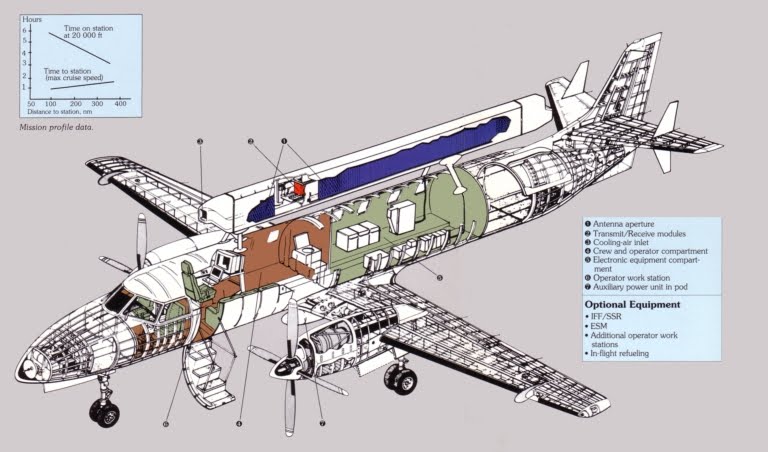
20th Erieye Radar System Delivered
With 20 systems produced, Erieye is by far the most successful modern AEW radar on the market today.
From the Saab plant in Gothenburg, Sweden, the 20th Erieye radar system has rolled out, ready to proceed to the next phase, installation on aircraft and final testing.
“This is a milestone in the on-going production and we are proud that seven countries around the world now have selected Erieye. Although it may look the same for an unaccustomed eye on the outside, the inside is newly developed, using our spiral development process. Despite this, we have delivered on time again” says Erik Winberg, Director Product Management AirborneSurveillance.
The Erieye radar, an Airborne Early Warning radar, is the first of its kind using AESA technology. Designed for use together with regional aircraft, it is today operational on three platforms.
The multi-role radar detects and automatically tracks air and surface targets over a huge area, covering 900 km in range. It is designed to track the smallest object in the air as well on the sea surface.
The applications are both military and for national security, where the use of the system in Brazil and Mexico for anti-drug operations is one example.
SKorea deploys Firefinder radar after NKorea barrage
Seoul: South Korea said Friday it had deployed advanced weapons-tracking radar systems on islands near its disputed Yellow Sea border with North Korea following last week's artillery barrages by the North.
Defence Minister Kim Tae-Young told lawmakers the AN/TPQ-36Firefinder systems had been set up on Baengnyeong and Yeonpyeongislands.
"A few days ago, deployment of anti-artillery radar systems was completed," the minister was quoted as saying by Yonhap news agency.
The system is designed to determine where incoming artillery and rocket fire originated, to allow for a possible counter-attack.
After declaring two "no sail" zones, the communist state last weekfired 370 shells into the sea near the border over three straight days,heightening tensions on the Korean peninsula.
Seoul's military said Wednesday the North had designated another two "firing zones" in the area, effective for four days from Friday, raising the prospect of more artillery fire.
The North said its salvoes last week were part of a routine winterexercise but South Korea and the United States described them asprovocative.
The Yellow Sea border was the scene of deadly naval battles in 1999and 2002 and of a firefight last November which left a NorthKorean patrol boat in flames.
Subscribe to:
Posts (Atom)